



The Interpreter Foundation is a nonprofit organization. All journal publications and video presentations are available for free by digital download and streaming. The price of hard copy versions of journal articles covers only the cost of printing; books are typically priced to help cover both upfront pre-publication expenses and royalties to authors when applicable. In some cases, the Foundation may subsidize publication costs to keep retail prices affordable. The Foundation does not profit from sales of its publications.
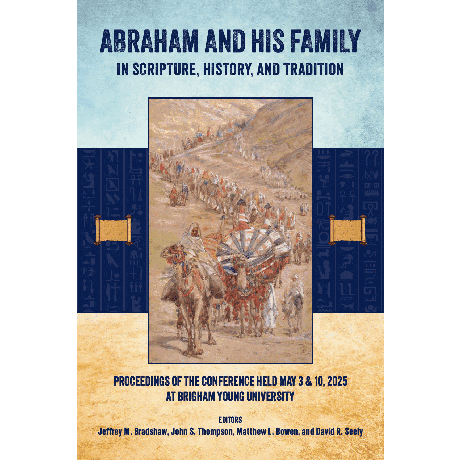
Abraham and His Family in Scripture, History, and Tradition
Proceedings of the Conference held May 3 & 10, 2025
at Brigham Young University
Sponsored by The Interpreter Foundation, Scripture Central,
BYU Religious Education, and FAIR
Edited by Jeffrey M. Bradshaw, John S. Thompson, Matthew L. Bowen, & David R. Seely
Published by The Interpreter Foundation and Eborn Books
Through Abraham’s faithfulness, he merited the stunningly universal promise of God that “in [him] shall all families of the earth be blessed” (Genesis 12:3). Latter-day Saints, in common with those in many other religious traditions, rejoice in the ongoing fulfillment of that promise. However, though the blessings patiently, and sometimes painfully, secured by his family through unwavering faith in the face of trial and heartache are well-documented in scripture, the wealth of insights that ancient and modern scholarship can shed on these scriptural accounts is generally underappreciated.
On 3 and 10 May 2025, scholars from Latter-day Saint and other traditions gathered at Brigham Young University to discuss the enduring legacy of Abraham and his immediate family in scripture, history, and tradition. A primary focus of the conference was its focus on covenant- and temple-related themes that have been deeply woven into relevant accounts in the Bible, the Qur’an, and other religious texts. In addition, believing that authentic history sits behind modern scripture, special emphasis was given to ancient threads relating to Abrahamic material in the Joseph Smith Translation of the Bible, the Book of Mormon, the Doctrine and Covenants, and the Book of Abraham.
This two-volume will increase the appreciation of readers for the trials and triumphs of the family of Abraham, Sarah, and Hagar. More importantly, it will enable them to more fully emulate their faithful lives to claim the fulness of blessings promised in the Abrahamic covenant.
Amazon
FAIR Bookstore
Eborn Books
Table of Contents
Studies in the Book of Abraham
- A Northern Mesopotamian Origin for Abraham? — Gary A. Rendsburg
- Approaching Eternal Life: Temple Elements by the Numbers in Facsimile 2 — John W. Welch and Michael D. Rhodes
- Abraham the Astronomer — Stephen O. Smoot
- “My Name Is the Sun”: Patriarchs, Planets, and the Book of Abraham — Allen Hansen and Spencer Kraus
- “I Abraham”: The Father of the Faithful in Light of the Book of Abraham — David Calabro
- “That Lineage”: Rival Priesthood Claims in the Book of Abraham — Avram R. Shannon
- Sons and Fathers: Abraham’s Family and the Two Altars of the Temple — John S. Thompson
- Proper Names and Foreign Words in the Book of Abraham — Stephen Ricks
- Perspectives on the Book of Abraham — Panel: David Calabro, Michael D. Rhodes, Stephen O. Smoot, and John S. Thompson
Studies of the Family of Abraham in the Bible, the Qur’an, and Other Traditions
- Echoes of the Temple and Jerusalem in the Abraham Story — Gary A. Rendsburg
- The Redeemer and the Redeemed — John Gee
- Ḥesed and the Redemption of Abraham — Jennifer C. Lane
- I Will Bless Thee and Make Thy Name Great”: Sacralizing Names and Spaces as a Function of Etiology in the Abrahamic Narrative — Matthew L. Bowen
- The Ten Tests of Abraham and Sarah: A Jewish Tradition Applied to Reading the Bible, Rabbinic Midrash and the Book of Abraham — David Seely
- “And They Shall Write It”: The Literacy and Scribalism of Abraham’s Josephite Descendants — Noel B. Reynolds
- The Qur’anic view of Abraham — Daniel C. Peterson
- Esoteric Traditions on Abraham: Rabbinic and Kabbalistic Sources, the New Testament, and the Qurʾān — Samuel Zinner
- Abraham: Man of Perfect Faith — Spencer Kraus and Allen Hansen
- Abram Meets Melchizedek, with Joseph Smith at the Reader’s Side — Jeffrey M. Bradshaw
- Personal Views on Abraham and His Family — Panel: Jeffrey M. Bradshaw, Jennifer C. Lane, Daniel C. Peterson, Gary A. Rendsburg, and John W. Welch
 Facebook
 X
X Youtube
 Tiktok
 Instagram