Authors

Matthew L. Bowen
Abstract: One of the most notable features of Nephi’s small plates rendition of Isaiah chapter 2 (2 Nephi 12) is the prominent expansion of the nations theme with two additional clauses with the word nations (Hebrew gôyim) that are not found in the Masoretic text (from which the KJV has been translated). Nephi’s text preserves the use of nations from Isaiah 2:2, 4 in 2 Nephi 12:2, 4, but also attests significant additional references to the nations in 2 Nephi 12:12, 14: “For the day of the Lord of Hosts soon cometh upon all nations, yea, upon every one . . . and upon all the nations which are lifted up, and upon every people.” These variants are consistent with—and may even be explained by—Nephi’s declaration of intent in 2 Nephi 25:3: “Wherefore, I write unto my people, unto all those that shall receive hereafter these things, which I write, that they may know the judgments of God, that they come upon all nations, according to the word which he hath spoken” (2 Nephi 25:3). This purpose in writing might explain additional textual variants in 2 Nephi 12–24 that pertain to coming judgments upon the nations, which is a dominant theme of the writings of Isaiah, which Nephi incorporated into this part of his record.
After the Isaiah-based portion of the Savior’s “covenant people”1 sermon (3 Nephi 16, 20–22), which concludes with a quotation of Isaiah 54 in its entirety (3 Nephi 22), the resurrected Lord declared:
[Page 202]And now, behold, I say unto you, that ye ought to search these things. Yea, a commandment I give unto you that ye search these things diligently; for great are the words of Isaiah. For surely he spake as touching all things concerning my people which are of the house of Israel; therefore it must needs be that he must speak also to the Gentiles. And all things that he spake have been and shall be, even according to the words which he spake. (3 Nephi 23:1–3)
Too often, modern readers think of the message of Isaiah merely as words directed to the Lord’s people in which the faithful may “delight” as Nephi does (see, for example, 2 Nephi 11:2). Here, however, the Lord suggests that much of Isaiah’s prophetic message is specifically written to and concerning the Gentiles or nations. In Hebrew, these two terms are identical: the lexeme gôyim or haggôyim is almost always translated nations, Gentiles, or heathen.2 Indeed, the English term Gentiles is simply a borrowing of the Latin word gentilis, which is used in ancient Latin translations of the Greek scriptures to render the Greek term (ta) ethnē (nations or, more specifically, “people groups foreign to a specific people group”3), which in turn translates the term gôyim from the original Hebrew scriptural texts.
Nephi recognized the importance of Isaiah’s message for the nations or Gentiles. He further recognized that a key aspect of the Abrahamic covenant was that Abraham not only would become father of a covenant people through Isaac (through whose lineage the Messiah would also descend), but also a “father of many nations” or “father of many Gentiles” (ʾab hamôn gôyim, see Genesis 17:4–5; see [Page 203]also Romans 4:17–18; Abraham 1:2). Indeed, the enlargement of the name Abram to Abraham with the addition of the letter he for hāmôn (construct form hamôn, “multitude”) is tied to this specific promise.4 After demonstrating total and unwavering faithfulness to the Lord through his willingness to sacrifice Isaac, Abraham received a final and full confirmation of the promise “in thy seed shall all the nations [kol gôyê] of the earth be blessed” (Genesis 22:18; see also Genesis 12:3; 18:18).5
The canonical text of Isaiah first mentions nations in Isaiah 2:2 (“and all nations shall flow unto it [i.e., the latter-day temple, discussed below])” and 2:4 (“and he shall judge among the nations”). One of the most notable features of Nephi’s text for Isaiah chapter 2 is the prominent expansion of the nations theme with two additional instances of nations that are not found in the Masoretic text from which the King James text has been translated. In other words, Nephi’s text preserves the use of nations from Isaiah 2:2 and 2:4 in 2 Nephi 12:2 and 12:4, but attests to significant additional references to the nations in 2 Nephi 12:12 (“For the day of the Lord of Hosts soon cometh upon all nations, yea, upon every one”) and 12:14 (“and upon all the nations which are lifted up, and upon every people”).
On one hand, it is possible that these universalizing additions in Nephi’s text reflect a more complete text available to him on the brass [Page 204]plates. On the other hand, it is also possible that these two additional references to the nations constitute Nephi’s own prophetic additions to Isaiah’s text consistent with his recognition of the importance of Isaiah’s message for the nations or Gentiles. In either case, the textual variants in 2 Nephi 12 emphasize the centrality of the nations in Isaiah’s and Nephi’s understandings of the Abrahamic covenant and how the Lord intends to completely fulfill that covenant.
Nephi thoroughly understood the necessity of the atoning sacrifice of Jesus Christ in bringing to pass the promises in that covenant (see 2 Nephi 25:11–20). Nephi also understood that the eschatological “day of the Lord of Hosts [that] soon cometh upon all nations” (2 Nephi 12:12), or the Second Coming of Jesus Christ, would be preceded by the Lord “proceed[ing] [yôsip] to do a marvelous work among the Gentiles” (paraphrasing Isaiah 29:14) through which the house of Israel would be “nursed by the Gentiles [haggôyim, nations]”6 (1 Nephi 22:8, following Skousen; alluding to Isaiah 49:22–23). Nephi knew that this work would be “of worth unto the Gentiles [haggôyim, nations]” and “unto all the house of Israel,” because it would fulfill the Abrahamic covenantal promise that “in thy seed shall all the kindreds [all the kōl gōyȇ, all the nations] of the earth be blessed” (1 Nephi 22:9, quoting Genesis 22:18). This is a promise that would require the Lord “proceed[ing] [yôsip] to make bare his arm in the eyes of the nations [haggôyim]” (1 Nephi 22:18; blend-quoting Isaiah 29:14 and Isaiah 52:10).7 As noted above, the word for nations and Gentiles in Hebrew is the same: gôyim.
Nephi’s overarching purpose in quoting Isaiah 2–14 is best summarized in the final verse of 2 Nephi 11:8:
And now I write some of the words of Isaiah, that whoso of my people shall see these words may lift up their hearts and rejoice for all men. Now these are the words, and ye may liken them unto you and unto all men.
In other words, the message of this block of Isaiah text is ultimately about both Jew and Gentile (“all men”) and ultimately one of potential hope for all. In this study, I will endeavor to show how the four instances of “nations” (Hebrew goyim) work together in Nephi’s rendition of Isaiah as one of the most significant prophetic messages in the Book [Page 205]of Mormon. I will also attempt to demonstrate that Nephi restates the essential substance of that message at the conclusion of his largest block of quoted Isaiah text:
Wherefore, I write unto my people, unto all those that shall receive hereafter these things which I write, that they may know the judgments of God, that they come upon all nations, according to the word which he hath spoken. (2 Nephi 25:3)
Perhaps even more than his frontend statement in 2 Nephi 11:8, this backend statement not only summarizes much of the content of 2 Nephi 12–24, but it potentially explains several significant textual variants within this block. In the end, Nephi’s inclusion of Isaiah’s prophecies about “the judgments of God”—positive and negative—coming upon “all nations” helps his readers see how the Lord intends to save the Gentiles, together with his people, Israel. Nephi’s soul “delight[ed] in proving . . . that save Christ should come all men must perish” (2 Nephi 11:6).
“And All the Nations Shall Flow unto It”: Isaiah’s Temple Prophecy
Nephi’s longest block of quoted text from Isaiah (and the longest in the entire Book of Mormon) begins with Isaiah’s prophecy of Gentiles “flow[ing] unto” the latter-day temple:
Table 1. Isaiah’s latter-day temple prophecy
| Isaiah 2:1–3 | 2 Nephi 12:1–3 |
|---|---|
| The word that Isaiah the son of Amoz saw concerning Judah and Jerusalem. And it shall come to pass in the last days, that the mountain of the Lord’s house shall be established in the top of the mountains, and shall be exalted above the hills; and all nations [kol-haggôyim] shall flow unto it.
And many people shall go and say, Come ye, and let us ago up to the mountain of the Lord, to the house of the God of Jacob; and he will teach us of his ways, and we will walk in his paths: for out of Zion shall go forth the law, and the word of the Lord from Jerusalem. |
The word that Isaiah, the son of Amoz, saw concerning Judah and Jerusalem: and it shall come to pass in the last days, when the mountain of the Lord’s house shall be established in the top of the mountains, and shall be exalted above the hills, and all nations [kol-haggôyim] shall flow unto it.
And many people shall go and say, Come ye, and let us go up to the mountain of the Lord, to the house of the God of Jacob; and he will teach us of his ways, and we will walk in his paths; for out of Zion shall go forth the law, and the word of the Lord from Jerusalem. |
[Page 206]Gentile inclusion,8 even in the Israelite-Judahite temple cult,9 is a major theme in the canonical book of Isaiah. Isaiah 2:1–3 is one of the earliest manifestations of that theme. The prophet Isaiah envisions kol-haggôyim, “all the nations” or “all the Gentiles” as possible participants in temple worship. The nations/Gentiles acknowledge Israel’s God—Yahweh, “the God of Jacob”—as their own God. Nephi clearly understood that Yahweh (or Jehovah) was Jesus Christ,10 and he would have viewed the temple worship described by Isaiah as Christ-centered temple worship (see, for example, 2 Nephi 25:29).
Isaiah’s use of the phrases kol-haggôyim (“all the nations/Gentiles”) and “many peoples” (ʿammîm rabbîm) in his prophecy has implications for the fulfillment of the Abrahamic Covenant, as Nephi clearly discerned (1 Nephi 22:6–12). When the Lord reiterated his covenant with Abram and when Abraham received the token of circumcision and the new name Abraham, the Lord promised him that he would become a “father of many nations” and that the name Abraham would be a sign of this promise:
As for me, behold, my covenant is with thee, and thou shalt be [become] a father of many nations [ʾab hamôn gôyim]. Neither shall thy name any more be called Abram, but thy name shall be Abraham; for a father of many nations [ʾab hamôn gôyim] have I made thee. And I will make thee exceeding fruitful, and I will make nations of thee [ûnĕtattîkā lĕgôyim], and kings shall come out of thee. (Genesis 17:4–6)
For Nephi, the implications of this temple prophecy for the ultimate fulfillment of the Abrahamic Covenant are that the participation or inclusion of the nations/Gentiles in the latter-day temple and its ritual system would enable them to be “numbered among the house of Israel” (1 Nephi 14:2; 2 Nephi 10:18–19). The temple that Nephi built in the land of Nephi appears to have offered this precise function for the inclusion of Gentile “others” among his people during his own time.11 [Page 207]Regarding Nephi’s inclusion of the Gentile “others” they encountered in the promised land into the nascent Nephite state, Brant Gardner writes,
Several parts of Isaiah 2 were applicable to the situation of the early Nephites. Verses 2–5 discuss the building of a temple as a gathering place for the people of Yahweh. Nephi’s people had built a temple, and “others” had come to it and joined with Nephi’s people.12
Nephi’s Isaiah text has a textual variant that also constitutes a significant Hebraism. Paul Y. Hoskisson observes that the use of when in the translation of 2 Nephi 12:2, is followed by two and clauses. The second of those can be read as then.13 Thus, “And it shall come to pass in the last days, when the mountain of the Lord’s house shall be established in the top of the mountains . . . then all the nations/gentiles shall flow unto it.” Hoskisson’s insight helps us to understand how the establishment of the latter-day temple is another inflection point for the fulfillment of the promises of the Abrahamic covenant that, in Jacob’s words, would enable “the Gentiles [to] be blessed and numbered among the house of Israel” (2 Nephi 10:18).
Isaiah’s use of the verb nāhar (flow, stream,14 stream towards15), from the same root that the Hebrew noun for river is also derived, creates the jarring image of a river of people flowing uphill.16 The nations/Gentiles [Page 208]will flow like an uphill river through the latter-day temple to become the seed of Abraham and heirs to all the blessings of Abraham, Isaac, and Jacob. The righteous among the nations/Gentiles who are taught the Lord’s “ways” (including the doctrine of Christ) and “walk in his paths” will be prepared for the divine judgment that will follow.
One could interpret nāhar as the morphologically identical verb nāhar (II), “shine, be radiant,”17 a verb that apparently derives from the Semitic/Hebrew root nwr (whence also comes nēr, “light,”18 “lamp”). If read that way, then “all nations shall flow unto it” could also be understood literally as “and all the nations shall shine on it,” or more lucidly in English, “and all the nations shall gaze on it with joy,” as the NJPS19 translation renders it. The prophecy of Isaiah 60:5, which more clearly uses nāhar (II), is probably better understood in this sense:
Then thou shalt see, and flow together [or, radiate joy], and thine heart shall fear, and be enlarged; because the abundance of the sea shall be converted unto thee, the forces of the Gentiles shall come unto thee. (KJV)
Then you shall see and be radiant; your heart shall thrill and rejoice, because the abundance of the sea shall be brought to you; the wealth of the nations shall come to you. (NRSVUE)
As you behold, you will glow; your heart will throb and thrill—for the wealth of the sea shall pass on to you, the riches of nations shall flow to you. (NJPS)
Nephi knew that the accessibility of the latter-day temple to all the nations or Gentiles (“And I will make all my mountains a way, and my highways shall be exalted,” Isaiah 49:11; 1 Nephi 21:11) has the potential to have a transformative effect upon the world. It had been revealed to Nephi that the Lord would not “suffer that the Gentiles shall forever remain in in that state of awful wickedness that they are in” (1 Nephi 13:32, following Skousen).20 Nephi’s message of hope to the Gentiles [Page 209]was and remains urgent, precisely because divine judgment is coming with the day of the Lord.
“And He Shall Judge Among the Nations”: Divine Judgment and Millennial Peace Among the Nations
The people of the same nations who “flow” riverlike to the latter-day temple in Isaiah 2:2–3/2 Nephi 13:2–3 are the focus of divine judgment in Isaiah 2:4/2 Nephi 2:4:
Table 2. Isaiah’s prophecy of divine adjudication of the nations
| Isaiah 2:4–5, KJV | 2 Nephi 12:4–5 |
|---|---|
| And he shall judge [wĕšāpaṭ] among [bēn, between] the nations [haggôyim], and shall rebuke [wĕhôkîaḥ] adjudicate (for)] many people [lĕʿammîm rabbîm]: and they shall beat their swords into plowshares, and their spears into pruninghooks: nation shall not lift up sword against nation, neither shall they learn war any more.
O house of Jacob, come ye, and let us walk in the light of the Lord. |
And he shall judge [wĕšāpat] among [bēn, between] the nations [haggôyim], and shall rebuke [wĕhôkîaḥ, adjudicate (for)] many people [lĕʿammîm rabbîm]: and they shall beat their swords into plow-shares, and their spears into pruning-hooks—nation shall not lift up sword against nation, neither shall they learn war any more.
O house of Jacob, come ye and let us walk in the light of the Lord; yea, come, for ye have all gone astray, every one to his wicked ways. |
Theodore J. Lewis notes that the phrase “judge among the nations” (wĕšāpaṭ bēn haggôyim)
can connote military action, as the root špṭ is indeed used in battle contexts, most notably in the book of Judges (for example, Judges 2:16). Blending with Yahweh the ultimate warrior whose might brings a disarmed surrender is Yahweh the ultimate teacher-judge.21
In other words, in “the day of the Lord,” the Lord will act as Divine Warrior, in a military capacity, if necessary, to bring about peace between all nations. Lewis further notes that
The disarmament of the nations is predicated on Yahweh’s “judging” via the teaching of his law (tôrâ) and practice [Page 210](dĕrākāyw//ʾōrḥōtāyw) as well as arbitration on an international scale (wĕhôkîaḥ lĕʿammîm rabbîm; Isa 2:4; cf. wěhôkîaḥ lěgôyim ‘ășumîm ‘adrāhôq; Mic 4:3).22
Nephi knew that the Lord would manifest himself in person to do this work of “judging” and “adjudicating” as is further suggested by his inclusion of Isaiah’s prophecy of the Davidic ruler and the Messianic age (the Millennium) from Isaiah 11 in 2 Nephi 21. One of the key texts of that prophecy uses the same two initial verbs in the same verbal forms in Isaiah 2:4/2 Nephi 12:4, namely šāpaṭ and yākaḥ: “But with righteousness shall he judge [wĕšāpaṭ] the poor, and reprove [wĕhôkîaḥ, adjudicate] with equity for the meek of the earth: and he shall smite the earth with the rod of his mouth, and with the breath of his lips shall he slay the wicked” (Isaiah 1:4/2 Nephi 21:4). Nephi knew that this Davidic ruler would be Jesus Christ, himself.
A lengthy textual variant in 2 Nephi 12:5 further establishes the connection between the prophecy of Isaiah 2 and Jesus Christ. Nephi’s text contains the additional invitation and declaration: “yea, come, for ye have all gone astray, every one to his wicked ways.” This additional sentence constitutes a startling intertextual link to the Suffering Servant Song of Isaiah 53, Isaiah’s great poem on the Messiah’s atonement: “All we like sheep have gone astray; we have turned every one to his own way; and the Lord hath laid on him the iniquity of us all” (Isaiah 53:6). Sin and apostasy are so universal among the nations that they require an atonement that is also universal or “infinite and eternal” (see Alma 34:10, 14). The common solution for “all” humankind is to repent and come unto Jesus Christ.
The twofold invitation to the house of Jacob to “come [ye]” and “walk” in the light of Yahweh (2 Nephi 12:5) is an invitation to come unto Christ consistent with Nephi’s stated purpose in writing in 1 Nephi 6:4: “For the fulness of mine intent is that I may persuade men to come unto the God of Abraham, and the God of Isaac, and the God of Jacob, and be saved.”
“The Day of the Lord Soon Cometh upon all Nations”: The Messiah’s Second Coming
From Amos to Malachi, prophecies about “the day of the Lord” (or the Day of Yahweh) occur frequently and conspicuously in ancient Judahite prophecy.23 The present canonical position of Malachi’s [Page 211]“great and dreadful day of the Lord”24 prophecy at the end of biblical Hebrew prophecy and the western Christian Old Testament, accords it prominence and gravity. As becomes evident in 2 Nephi 25, Nephi understood ancient Judahite prophecies of “the day of the Lord,” including those made by Isaiah, to refer to the Second Coming of Jesus Christ. Nephi’s text makes clear that “the day of the Lord” would not simply come upon the proud, but that it would come upon “all nations”/“Gentiles,” and even upon everyone, particularly the proud:
Table 3. Isaiah’s prophecy of a universal day of the Lord (I).
| Isaiah 2:12–13 | 2 Nephi 12:12–13 |
|---|---|
| For the day of the Lord of hosts shall be upon every one that is proud and lofty, and upon every one that is lifted up; and he shall be brought low:
And upon all the cedars of Lebanon, that are high and lifted up, and upon all the oaks of Bashan, |
For the day of the Lord of Hosts soon cometh upon all nations, yea, upon every one; yea, upon the proud and lofty, and upon every one who is lifted up, and he shall be brought low.
Yea, and the day of the Lord shall come upon all the cedars of Lebanon, for they are high and lifted up; and upon all the oaks of Bashan; |
Nephi’s text differs from the Masoretic text (and the King James text) of Isaiah 2:12 with the preservation or inclusion of the qualifying phrases “soon cometh upon all nations” and “the day of the Lord shall come” fronted by the intensifying particle, “Yea.” These additions in Nephi’s text underscore both the temporal immediacy of the day of the Lord and the urgency of Nephi’s message to the Gentiles. The day of the Lord will come upon all the “nations” or “Gentiles,” some of whom are repentant and “flowing” to the latter-day temple in Isaiah 2:2/2 Nephi 12:2 and those who choose to remain in their awful state of wickedness and are thus the recipients of divine severity in judgment in Isaiah 2:4/2 Nephi 12:4. Nephi’s text further stresses the foregoing through the word Yea, which could represent any of one of the Hebrew words ʾap, wĕ/û-, gam, kî, as well as through the use of the more usual formulation “day of the Lord” (yôm yhwh): “Yea, . . . the day of the Lord shall come.”
[Page 212]“Upon All the Nations Which Are Lifted Up”: The Pride of the Nations in the Latter Days
Hebrew terms that denote highness or elevation are also the terms that denote pride in that language. For example, rām (rûm, “to be high above,” “to reach high,” “to be exalted,” “to rise, go up”; “to lift oneself up proudly”),25 niśśāʾ (from nāśāʾ, “to carry,” “to lift, lift up,” “to lift up the head, hold the head high”26), gēʾâ (from gāʾâ, “to be high, to grow tall”; “to be arrogant”),27 gābēah (gabāh, “to be high,” “to be exalted,” “to be haughty).28 In later Nephite-Lamanite history, Mormon describes the Zoramites and their “high” Rameumpton (Hebrew rām)29 as a type of the elevation and pride that would characterize the latter-day nations/Gentiles who would also be lifted up.
Table 4. Isaiah’s prophecy of a universal day of the Lord (II).
| Isaiah 2:14–17 | 2 Nephi 12:14–17 |
|---|---|
| And upon all the high mountains, and upon all the hills that are lifted up,
And upon every high tower, and upon every fenced wall, And upon all the ships of Tarshish, and upon all pleasant pictures. And the loftiness of man shall be bowed down, and the haughtiness of men shall be made low: and the Lord alone shall be exalted in that day. |
And upon all the high mountains, and upon all the hills, and upon all the nations which are lifted up, and upon every people;
And upon every high tower, and upon every fenced wall; And upon all the ships of the sea, and upon all the ships of Tarshish, and upon all pleasant pictures. And the loftiness of man shall be bowed down, and the haughtiness of men shall be made low; and the Lord alone shall be exalted in that day. |
Nephi’s Isaiah text at once emphasizes and clarifies who is lifted [Page 213]up, particularizing the metaphor: “the nations” are “lifted up”—that is, guilty of pride—and that they will not escape “the day of the Lord.” While “high mountains” and “hills that are lifted” can easily be metonymous for proud people, as in Isaiah’s text, pride is a particular sin of “all the nations.” Brant Gardner suggests that “The Book of Mormon is here more specific and less symbolic than KJV Isaiah about Yahweh’s conquering all people who are lifted up.”30
The Masoretic text of Isaiah 2:14 is a simple bicolon, or figure of speech, consisting of parallel phrases. Nephi’s text in 2 Nephi 12:14 can be viewed as either a quadricolon or two bicola. The additional bicolon in this verse does not disrupt the flow evident in the Masoretic text.
Both the Masoretic text of Isaiah 2:15 and Nephi’s rendition in 2 Nephi 12:15 constitute a bicolon. The bigger issue arises in 2 Nephi 12:16, in which the Masoretic text of Isaiah 2:16 is also a bicolon. Nephi’s text is a tricolon. The colon “And upon all the ships of the sea” is not present in the Masoretic text, although something very close to it appears in the Septuagint: kai epi pan ploion thalassēs (“and upon every ship of the sea”).
Dana M. Pike and David Rolph Seely have wisely cautioned against simply defaulting to the assumption that this tricolon represents a more original text and have discussed the more complex textual critical issues surrounding this verse.31 Gardner sees “upon all the ships of the sea” as Joseph Smith’s “addition to clarify the KJV passage.”32 One problem with this solution, however, is that clarifying glosses are almost always added after, and not before, the material they are intended to clarify.
The phrase “upon all the ships of the sea” may well represent an ancient variant preserved on the brass plates. The Septuagint variant kai epi pan ploion thalassēs (“and upon every ship of the sea”) alone makes this highly plausible. Another possible solution—and still better than casting about for a modern source—is that the phrase “upon all the ships of the sea” is Nephi’s own universalizing addition to the text, which also appears to be true of the addition of the clauses in 2 Nephi 12:14, “and upon all the nations which are lifted up, and upon [Page 214]every people.” The clause, “upon all the ships of the sea,” like these other clauses, emphasizes the universality of the day of the Lord. The day of the Lord will come upon all the ships of the sea, including those of Tarshish. If Nephi was writing, as he says, “that they [his people and all who would receive his record] may know the judgments of God, that they come upon all nations, according to the word which he hath spoken” (2 Nephi 25:3), such additions would closely align with one of Nephi’s most significant stated purposes in writing. In sum, “upon all the ships of the sea” could have been on the brass plates, but it is also possible that it, along with the other textual additions in 2 Nephi 12–24, originates with Nephi himself.
The Masoretic text of Isaiah 2:17 and Nephi’s text in 2 Nephi 12:17 are both structured as a tricolon: “And the loftiness of man [ʾādām] shall be bowed down, and the haughtiness of men [ʾănāšîm] shall be made low; and the Lord alone shall be exalted in that day.” This presence of the tricolon here means that it need not be regarded as irregular elsewhere in this text. The use of the matching terms ʾādām (“man”) and ʾănāšîm (“men”), as in the Masoretic text, again stresses the universality of the coming day of the Lord and contrasts the reduction of human self-importance with the Lord’s glory. In terms of Nephi’s message, these are the same “men” for whom he said that his people might “rejoice” and to whom they might liken Isaiah’s words (2 Nephi 11:8).
“That They May Know the Judgments of God, That They Come upon All Nations”: Nephi’s Purpose in Writing
The greatest concentrations of nations/Gentiles in Nephi’s Isaiah text are in 2 Nephi 12 (four times), at the beginning of Nephi’s long quotation of Isaiah, and in 2 Nephi 23–24 (six times, seven if one counts the pluralizing of the singular gôy), the end of his long Isaiah quotation. These concentrations in the prophecy of the latter-day temple and day of the Lord on the front end and in the burdens of Babylon and Philistia on the back end help form a kind of literary bracketing around Nephi’s quotation of Isaiah 2–14, as shown in the table 5.
Table 5. Nations/Gentiles in 2 Nephi 12–24.
| Nations/Gentiles in 2 Nephi 12–24 | Verses | # of instances |
|---|---|---|
| Bookend #1 (Isaiah 12)
Latter-day “temple” “day of the Lord” prophecy |
2 Nephi 12:2, 4, 12, 14 | Four |
| [Page 215]Judgment against Israel | 2 Nephi 15:26 | One |
| “Galilee of the Nations” | 2 Nephi 19:1 | One |
| Assyria punish “nations” | 2 Nephi 20:7 | One |
| Gathering of Israel through the agency of the Gentiles/nations | 2 Nephi 21:10, 12 | Two |
| Bookend #2 (Isaiah 13–14)
The Burdens of Babylon, Philistia |
2 Nephi 23:4; 24:6, 9, 12, 18, 26, 32 | Six, plus one instance (v. 32, singular gôy often rendered plural in translation) |
The opening bookend describes a “vision” that would “come to pass in the last days, when the mountain of the Lord’s house shall be established in the top of the mountains, and shall be exalted above the hills, and all nations shall flow unto it.” Regarding this temple, “many people[s] shall go and say, Come ye, and let us go up to the mountain of the Lord, to the house of the God of Jacob; and he will teach us of his ways, and we will walk in his path” because “out of Zion shall go forth the law, and the word of the Lord from Jerusalem” (2 Nephi 12:1–3). The bookend closes with very similar notes: “What shall then answer the messengers of the nation[s]? That the Lord hath founded Zion, and the poor of his people shall trust in it” (2 Nephi 24:32). As Sheri L. Klouda notes: “First and foremost, . . . Zion denotes the location of Yahweh’s dwelling place and immediate presence, symbolizing a place of security or safety (Psalms 45:4–6; 76:2–3),”33 This makes Nephi’s framing at Isaiah 2:1–3 and 14:32 particularly appropriate (more on this below).
In the chapters between these bookends, Nephi’s text quotes some intriguing Isaianic references to the nations/Gentiles that bear on, and contribute to, his overall message regarding the nations: 2 Nephi 15:26; 19:1; 20:7; 21:10, 12. In what follows, I will briefly examine these passages, but will not do so sequentially.
“By the way of the Red Sea beyond Jordan in Galilee of the nations”
Isaiah 9:1 and 2 Nephi 19:1 preserve a geographical reference to “Galilee of the nations” or “Galilee of the Gentiles” (as rendered in [Page 216]the King James version of Matthew 4:15, which quotes Isaiah 9:1; see below). Nephi’s text reads thus:
Nevertheless, the dimness shall not be such as was in her vexation, when at first he lightly afflicted the land of Zebulun, and the land of Naphtali, and afterwards did more grievously afflict by the way of the Red Sea beyond Jordan in Galilee of the nations.
Believing Latter-day Saint scholars have sometimes noted that the variant reading “Red Sea” (instead of “sea”) in Nephi’s text may represent an “error” in the Book of Mormon text.34 Non-believing scholars and critics have dismissed it as evidence of Joseph Smith’s ignorance. However, this textual variant may actually constitute yet another example of an “error” that really is not an error at all. E. Jan Wilson argues that the rare geographic term sûpă might underlie “Red Sea” (normally yam sûp), as the King James translators render it in Numbers 21:14.35 He further suggests that “Galilee of the nations” (gĕlîl haggôyim) in the Masoretic text and probably on the brass plates really denotes “district of the nations.”36 Whether Wilson’s solution or D. Charles Pyle’s suggestion regarding the King’s Highway as the “way of the Red Sea”37 is to be accepted, Nephi’s text appears to move the location of the eschatological re-fulfillment of this text eastward into the territory of “the nations.”
By Nephi’s time, the Assyrian invasion had long since brought the Northern Kingdom to a complete end (721 BCE). Isaiah had mentioned that “it is in his heart to destroy and cut off nations not a few” (Isaiah 10:7; 2 Nephi 20:7). The king of Assyria would be the instrument of divine judgment, but then also its object. Nevertheless, for Nephi, who saw “the course of the Lord [as] one eternal round” (1 Nephi 10:19), [Page 217]the historical events recorded within the prophecies of Isaiah could have multiple fulfillments, like the prophecies themselves. Nephi was aware of the historical fulfillment of Isaiah 9:1 [MT 8:23], but he could also have seen it as having an eschatological one. It is worth considering the relationship between “Red Sea” in Nephi’s text and a latter-day or eschatological fulfillment of Nephi’s prophecy.
When foreign armies—the armies of “the nations,” like Assyria and Babylonia—invaded Israel and Judah, they typically came from the northeast. It was much more difficult to invade by crossing the deserts from the eastern direction. These armies came from the northeast from the direction of the King’s Highway, which subsequently becomes “the way of the Red Sea” in the land “beyond Jordan” (see figure 1). For Nephi, the phrase “the way of the Red Sea” seems to have located the fulfillment of the prophecy in Isaiah 9 in the vicinity of where Moses raised up the brazen serpent: “And they journeyed from mount Hor by the way of the Red sea, to compass the land of Edom: and the soul of the people was much discouraged because of the way” (Numbers 21:4). Did Nephi identify the location where Moses lifted a serpent-seraph upon a nēs (Numbers 21:5–9) as the first place where [Page 218]the Lord “lift[ed] up” an “ensign” (nēs) to “the nations?” A comparison between 2 Nephi 25:20 and Isaiah 11:10, 12 suggests that Nephi saw a conceptual relationship between these texts, especially given his idiosyncratic use of nations to describe the tribes of Israel in 2 Nephi 25:20.38 Jesus’s own disciples saw his Galilean ministry as a fulfillment of the prophecy in Isaiah 9 (see Matthew 4:14–16). For Nephi, the ultimate fulfillment of Isaiah 9:6–7/2 Nephi 19:6–7 would be in the “day of the Lord”:
For unto us a child is born, unto us a son is given; and the government shall be upon his shoulder; and his name shall be called, Wonderful, Counselor, The Mighty God, The Everlasting Father, The Prince of Peace. Of the increase of government and peace there is no end, upon the throne of David, and upon his kingdom to order it, and to establish it with judgment and with justice from henceforth, even forever. The zeal of the Lord of Hosts will perform this.
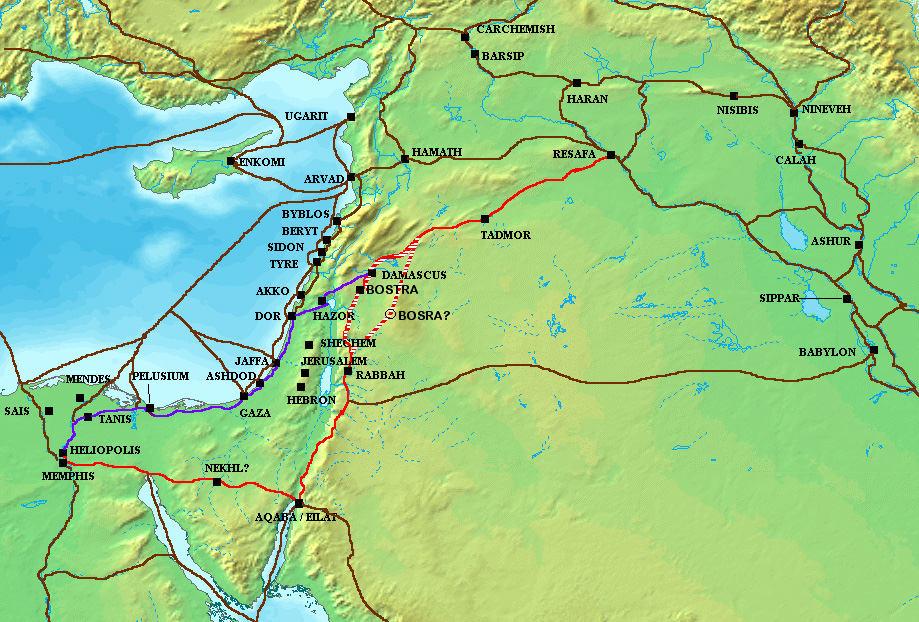
Figure 1. The King’s Highway runs out of Mesopotamia to Damascus and then south-southwest through the Transjordanian territories to the Elat and the Gulf of Aqaba where it turns west toward Egypt. upload.wikimedia.org/wikipedia/commons/e/ed/Ancient_Levant_routes.png.
The prophetic promises in verse 7 particularly require conditions that will be brought about by the day of the Lord upon the nations.
“An ensign to the nations,” “to him shall the Gentiles seek”
In Isaiah 2–14/2 Nephi 12–24, Isaiah three times uses similar language to describe the “lifting up” or “raising” of an “ensign,” “standard,” or “banner” (Hebrew nēs) as a signal to “the nations.” In the first instance, the nēs summons foreign or gentile armies to attack and scatter Israel: “he will lift up an ensign to the nations [wĕnāśāʾ-nēs laggôyim] from far” (Isaiah 5:26; 2 Nephi 15:26). In this case, the “nations,” particularly the Assyrians, are the instrument of the Lord’s judgment upon Israel and Judah.
In the second instance, the ensign is lifted up for expressly the opposite reason: “And he shall set up an ensign [wĕnāśāʾ nēs laggôyim] for the nations, and shall assemble [wĕʾāsap] the outcasts of Israel, and gather together [yĕqabbēṣ] the dispersed of Judah from the four corners of the earth” (Isaiah 11:12; 2 Nephi 22:12).
A very similar concept gained currency with Nephi and his successors:
[Page 219]Thus saith the Lord God, Behold, I will lift up mine hand to the Gentiles [gôyim, nations], and set up my standard [nissî, my ensign] to the people: and they shall bring thy sons in their arms, and thy daughters shall be carried upon their shoulders. (Isaiah 49:22)
This is a text quoted or alluded to in 1 Nephi 21:22; 22:6–8 and in 2 Nephi 6:6; 29:2. Nephi understood that, historically and in the future (including the eschatological future), the “nations” or “Gentiles” (haggôyim) were the divine means of scattering and gathering Israel as they had been in times past (for example, Assyria) and would also be the instrument and object of divine judgment.
The figure of “a root of Jesse,” foretold in Isaiah 11:10/2 Nephi 21:10, would be one from whom the Gentiles responsible for this gathering would “seek” or “inquire of”: “And in that day there shall be a root of Jesse, which shall stand for an ensign [nēs] of the people; to it [him] shall the Gentiles [gôyim] seek: and his rest shall be glorious.” Nephi would have understood this prophecy, unmistakably of a Davidic figure, as a prophecy about the Second Coming of the Messiah in glory (see, for example, 2 Nephi 25:16–18).
Another instance of the lifting of an ensign as a signal to “the nations” in these chapters occurs in Isaiah 13:2/2 Nephi 23:2: “Lift ye up a banner [śĕʾû-nēs] upon the high mountain, exalt the voice unto them, shake the hand, that they may go into the gates of the nobles.” This signal to the Lord’s “sanctified ones” and “mighty ones” (Isaiah 13:3; 2 Nephi 23:3) culminates in “a tumultuous noise of the kingdoms of nations [mamlĕkôt gôyim] gathered together” against Babylon (Isaiah 13:4).
Nephi saw history and prophecy as cyclical. Some of Isaiah’s prophecies had been fulfilled before his time. Others would be fulfilled during his time and still others long afterward, some of them more than once (see also Isaiah 7:14; 2 Nephi 17:14; Matthew 1:21–23).39 The “nations,” having played a crucial role in the destruction of the Babylon of Nephi’s own time, will also play a crucial role in the eschatological destruction of spiritual Babylon. But the latter-day Gentiles, like the nations of Nephi’s time, would need to repent in order to avert divine [Page 220]judgments (the story of Nineveh in the book of Jonah furnishes an excellent example of what such Gentile repentance might look like).
“Thou . . . which didst weaken the nations”: The fall of the king of Babylon as the defeat of Satan
Nephi’s large Isaiah block concludes with “the burden of Babylon, which Isaiah the son of Amoz did see” (Isaiah 13:1–14:27/2 Nephi 23:1–24:27) and “the burden” that came “in the year king Ahaz died” (Isaiah 14:28–32/2 Nephi 24:28–32). Both belong to the same literary unit. The latter constitutes something of an epilogue or appendix of the former. Numerous other “burdens” of the nations follow in the canonical book of Isaiah as currently ordered, but Nephi shows concern only for the contents of the “burden of Babylon” and the short burden that follows.
Isaiah uses a māšāl—a parable (literally, a likening, a comparison), or as some scholars have described it, a “taunt song”—to compare the king of Babylon to a figure designated hêlēl ben-šāḥar in the Hebrew text. That figure’s name was rendered “Lucifer, son of the morning” by the King James translators (following the Latin Vulgate and other earlier English translations) and in the Book of Mormon (2 Nephi 24:12). Isaiah vividly describes the motivations and ultimate fall of this figure: “How art thou fallen from heaven, O Lucifer, son of the morning! how art thou cut down to the ground, which didst weaken the nations [ḥôlēš ʿal-gôyim]!” (Isaiah 14:12; 2 Nephi 24:12). Isaiah describes him as “he that ruled [rōdeh] the nations [gôyim] in anger [bāʾap]” (Isaiah 14:6), meaning he exercised dominion over the Gentiles using oppression, persecution, destructive violence, and incarceration as means of maintaining his power and control.
After the fall of the king of Babylon, Isaiah says of the former’s arrival among the denizens of the spirit world, “it [Sheol] hath raised up from their thrones all the kings of the nations [kol malkê gôyim]” (Isaiah 14:9). Every one of the kings of the nations/Gentiles receive some measure of glory in their burial and afterlife, but not the king of Babylon: “All the kings of the nations [kol malkê gôyim], yea, all of them, lie in glory, every one of them in his own house. But thou art cast out of thy grave like an abominable branch . . . ” (Isaiah 14:18–19; 2 Nephi 24:18–19).
Nephi saw the eschatological fall of spiritual Babylon and Satan as its founder (see also 1 Nephi 14:12–17). He explains how, in the day of the Lord Jesus Christ, this being would be deprived of his power:
And he [the Lord] gathereth his children from the four [Page 221]quarters of the earth; and he numbereth his sheep, and they know him; and there shall be one fold and one shepherd; and he shall feed his sheep, and in him they shall find pasture. And because of the righteousness of his people, Satan has no power; wherefore, he cannot be loosed for the space of many years; for he hath no power over the hearts of the people, for they dwell in righteousness, and the Holy One of Israel reigneth. (1 Nephi 22:25–26; compare Revelation 21:1–10)
At the day of the Lord, the very “nations” who had been “weaken[ed]” and “rule[d]” by this being will eventually become completely safe from his influence: “But, behold, all nations, kindreds, tongues, and people shall dwell safely in the Holy One of Israel if it so be that they will repent” (1 Nephi 22:28).
“The hand that is stretched out upon all nations”
What happened to Babylon and its king will happen to the other nations that oppose the Lord in the day of the Lord. In another shorter oracle against the Assyrians who, historically speaking, would lose their power to the Babylonians, Isaiah declares: “This is the purpose that is purposed upon the whole earth; and this is the hand that is stretched out upon all nations [wĕzōʾt hayyād hannĕṭûyâ ʿal-kol-haggôyim]” (Isaiah 14:26/2 Nephi 24:26). J. Blake Couey writes,
In this couplet, Isaiah describes the far-reaching control that Yhwh exercises over all nations. The conspicuous length of the two lines creates a sense of expansiveness appropriate for the grand theological claim.40
The image of the outstretched hand,41 in this case stretched out against all the nations/Gentiles beginning with Assyria and subsequently Babylon, is clearly an image of divine judgment. The Lord’s eternal “purpose” (ʿēṣâ) or “plan”—as shown, for example, to Lehi in 1 Nephi 1:13–14—was “roll[ing] on.” Moroni later testified of this in Mormon 8:22–23, “For the eternal purposes [ʿēṣôt] of the Lord shall [Page 222]roll on, until all his promises shall be fulfilled. Search the prophecies of Isaiah.” For Nephi and his successors, past and present judgments upon the nations were proof of his future fulfillment of the Abrahamic Covenant and all its promises.
At the end of Isaiah 14/2 Nephi 24 there is a short “burden” or oracle against Philistia. Nephi chooses the question and answer that conclude this oracle as the conclusion for his long quotation of Isaiah: “What shall then answer the messengers of the nations [malʾăkê-gôy, messengers of a nation]? That the Lord hath founded Zion, and the poor of his people shall trust [yeḥĕsû, take refuge] in it.” 42 This final declaration—the message to any inquiring nation—is that the poor among the Lord’s people—the economically poor and the poor in spirit—can take refuge (yeḥĕsû) in Zion and its king, Yahweh. In view of the clear tabernacle-temple imagery characterizing Mount Zion as a “a place of refuge” (maḥseh) in Isaiah 4:5–6 and 2 Nephi 14:5–6 and the temple as the place par excellence of “taking refuge” under the Lord’s “wings,”43 perhaps symbolized by the seraphim (compare 2 Nephi 16:2–7 with 2 Nephi 25:20). Nephi is ending his Isaiah block where he began: with the temple and the nations.
Part of Nephi’s message of hope is this: the nations/Gentiles can come unto Christ and embrace his gospel and be numbered with his covenant people or remain under the power of the king of Babylon/Lucifer who “rules” the unconverted nations. It they do the latter, they will be subject to the severity of the divine judgments upon the wicked that accompany “the day of the Lord” that is coming upon all the nations.
Upon concluding this lengthiest of his Isaianic quotations, Nephi gives what Isaiah scholar Donald W. Parry has described as “five keys” [Page 223]for understanding the writings of Isaiah.44 Nephi asserts regarding the ancient inhabitants of the kingdom of Judah that “their works were works of darkness, and their doings were doings of abominations” (2 Nephi 25:2). Parry interprets this as the second “key” to understanding Isaiah words: “Do not do ‘works of darkness’ or ‘doings of abominations.’” 45 Ancient Judahites, however, had no monopoly on such practices. In his midrash of 2 Nephi 29, Nephi later writes “all the nations of the Gentiles and also the Jews . . . will be drunken with iniquity and all manner of abominations” (2 Nephi 27:1). Here the collocation “nations of the Gentiles” could be represented by a single underlying term, gôyim. Alternatively, it could also idiomatically render a phrase like “kingdoms of [the] nations/Gentiles” in Isaiah 13:4.
Immediately after his implicit warning against the “works of darkness” and “doings of abominations,” Nephi with the sum and substance of “the nations” theme in 2 Nephi 12, and perhaps 2 Nephi 12–24 as a whole, warns in 2 Nephi 25:3, “Wherefore, I write unto my people, unto all those that shall receive hereafter these things which I write, that they may know the judgments of God, that they come upon all nations, according to the word which he hath spoken.”
As noted earlier, Nephi knew well the role of the “nations” in “scattering” and in their eventually gathering as a part of the eschatological gathering of Israel:
Wherefore, the Jews shall be scattered among all nations; yea, and also Babylon shall be destroyed; wherefore, the Jews shall be scattered by other nations. And after they have been scattered, and the Lord God hath scourged them by other nations for the space of many generations, [Page 224]yea, even down from generation to generation until they shall be persuaded to believe in Christ, the Son of God, and the atonement, which is infinite for all mankind—and when that day shall come that they shall believe in Christ, and worship the Father in his name, with pure hearts and clean hands, and look not forward any more for another Messiah, then, at that time, the day will come that it must needs be expedient that they should believe these things. (2 Nephi 25:15–16)
Iterative, restorative, divine action would necessarily precede any large-scale Jewish belief in Jesus as the Messiah and in his Atonement:
The Lord will set his hand again [yôsîp] the second time to restore his people from their lost and fallen state [quoting Isaiah 11:11]. Wherefore, he will proceed [yôsip/yôsīp] to do a marvelous work and a wonder among the children of men [quoting Isaiah 29:14]. (2 Nephi 25:17)46
These Isaianic prophecies will be fulfilled through the writings of Nephi and his successors in order that “the promise may be fulfilled unto Joseph [yôsēp], that his seed should never perish as long as the earth should stand” (2 Nephi 25:21; see also 2 Nephi 2:3–4; 16; 23–24). They would also come in fulfillment of promises made to Nephi himself (see 2 Nephi 29:1–2).
This brings us to easily the most interesting, if not the most significant, use of nations in Nephi’s Isaiah-adjacent commentary:
And now, my brethren, I have spoken plainly that ye cannot err. And as the Lord God liveth that brought Israel up out of the land of Egypt, and gave unto Moses power that he should heal the nations after they had been bitten by the poisonous serpents, if they would cast their eyes unto the serpent which he did raise up before them, and also gave him power that he should smite the rock and the water should come forth; yea, behold I say unto you, that as these things are true, and as the Lord God liveth, there is none other name given under heaven save it be this Jesus Christ, of which I have spoken, whereby man can be saved. (2 Nephi 25:20)
[Page 225]Nephi’s description of ancient Israel in the wilderness as “the nations”—Hebrew haggôyim—is highly unusual in that this term is normally used to describe non-Israelites and non-Jews. However, the description of Israel as “the nations” is not entirely without precedent. Hebrew lexicographers Ludwig Koehler and Walter Baumgartner cite Genesis 18:18, Isaiah 60:22, Ezekiel 35:10, and Psalm 106:5 as examples where Israel itself is conceived of as a gôy.47 this occurs mostly in connection with the Abrahamic Covenant. The oracle of divine judgment against Seir-Edom in Ezekiel 35:10 describes Israel and Judah as “these two nations,” literally, “two of the nations” (šĕnê haggôyim).
What’s more, Nephi’s description of the “rais[ing] up” of the serpent that “heal[s] the nations” may have oblique reference to the servant song of Isaiah 52:13–15, and its image of the Servant who would “be exalted and extolled, and be very high” and would “sprinkle [yazzeh] many nations”—or, as the Joseph Smith Translation renders it, “gather many nations.”
Margaret Barker has described the Levitical “atonement” rite of kpr performed in the tabernacle, and later the Jerusalem temple, as “the ritual of healing and restoration.”48 Barker further notes the use of the verb yazzeh, “sprinkle” (from the root nzy/nzh), as constituting an essential part of the Levitical “atonement” rite (see, for example, Leviticus 16) in Isaiah 52:15.49 Thus, “heal the nations” in 2 Nephi 25 could be more precisely understood in the sense “perform the rite of atonement on many nations.” Nephi himself clearly understood the bronze serpent of Numbers 21 as a type of the Messiah’s sacrifice (see John 3).50 Understanding the phrase “healing the nations” as “atoning the nations” also accords nicely with the rendering of Isaiah 52:15 in the Joseph Smith Translation: “he shall gather many nations.” The possibility also exists that Nephi is identifying the nēs (“pole”) of Numbers 21 with Isaiah’s nēs—the “ensign,” “banner,” or “standard” of Isaiah 11:12, 49:22, and elsewhere—used to “gather” Israel by means of “the nations”/“Gentiles.”
[Page 226]The Lord provided the following statement regarding Isaiah’s message in 3 Nephi 23:2: “For surely [Isaiah] spake as touching all things concerning my people which are of the house of Israel; therefore it must needs be that he must speak also to the Gentiles [nations].” One unmistakable instance in which Isaiah speaks directly to the Gentiles or the nations occurs in Isaiah 34:1–2:
Come near, ye nations [gôyim], to hear; and hearken, ye people: let the earth hear, and all that is therein; the world, and all things that come forth of it. For the indignation of the Lord is upon all nations [ʿal-kol-haggôyim], and his fury upon all their armies: he hath utterly destroyed them, he hath delivered them to the slaughter.
Nephi recognized that Isaiah 2 (2 Nephi 12) delivered a similar message: “he shall judge among the nations” (2 Nephi 12:4):
Wherefore, these things [Nephi’s writings, including his quotations of Isaiah’s writings] shall go from generation to generation as long as the earth shall stand; and they shall go according to the will and pleasure of God; and the nations who shall possess them shall be judged of them according to the words which are written. (2 Nephi 25:22)
Isaiah’s and Nephi’s writings have lost none of their relevance for the Lord’s people or for “the nations” (Gentiles).
Summary and Conclusions
On the title page of the Book of Mormon, Moroni describes Jesus Christ as “the Eternal God, manifesting himself unto all nations.” Moroni knew, like his predecessors, Isaiah and Nephi, that the day of the Lord would one day come “upon all nations” (2 Nephi 12:12), even “upon all the nations which are lifted up” (2 Nephi 12:14).
In one of Nephi’s most significant stated purposes in writing, he declares, “Wherefore, I write unto my people, unto all those that shall receive hereafter these things which I write, that they may know the judgments of God, that they come upon all nations, according to the word which he hath spoken” (2 Nephi 25:3).
This statement is not only consistent with the variant readings in Nephi’s rendition of Isaiah 2 in 2 Nephi 12, but it credibly explains them. Nephi’s knowledge of—and emphasis on—the universality of the day of the Lord and the coming judgments “upon all nations” also [Page 227]potentially explains variants that have drawn significant attention, like the tricolon in 2 Nephi 12:16, which begins with the additional phrase “upon all the ships of the sea.” Nephi’s view that historical events and prophecy could recur, such as the divine judgments upon the nations mentioned in 2 Nephi 19:1 (“and [the Lord] did more grievously afflict by the way of the Red Sea beyond Jordan in Galilee [or the district of] the nations”) might also explain that variation as an event transpiring in Gentile territory.
Jesus Christ himself warned that the latter-day “Gentiles” in Lehi’s promised land would
sin against my gospel, and shall reject the fulness of my gospel, and shall be lifted up in the pride of their hearts above all nations, and above all the people of the whole earth, and shall be filled with all manner of lyings, and of deceits, and of mischiefs, and all manner of hypocrisy, and murders, and priestcrafts, and whoredoms, and of secret abominations. (3 Nephi 16:10)
He further declared, “If they shall do all those things, and shall reject the fulness of my gospel, behold, saith the Father, I will bring the fulness of my gospel from among them” (3 Nephi 16:10). The gospel would go forth from these Gentiles to the remnant of the house of Israel throughout the world. They would themselves have the opportunity to repent and join themselves to the house of Israel: “But if the Gentiles will repent and return unto me, saith the Father, behold they shall be numbered among my people, O house of Israel” (3 Nephi 16:13; see also 3 Nephi 21:22).
But if they will not turn unto me, and hearken unto my voice, I will suffer them, yea, I will suffer my people, O house of Israel, that they shall go through among them, and shall tread them down, and they shall be as salt that hath lost its savor, which is thenceforth good for nothing but to be cast out, and to be trodden under foot of my people, O house of Israel. (3 Nephi 16:15)
Nephi knew well the peril that awaited the unrepentant among “all the nations” or Gentiles and hoped to help them avert it. His selection of Isaiah 2–14 for wholesale inclusion in 2 Nephi 12– 24, especially 2 Nephi 12 with its universalizing and clarifying emphases on the day of the Lord coming upon “all nations” points exactly in this direction. It is conclusively declared in 2 Nephi 25:3.
[Page 228]Modern revelation further confirms that the Lord will not “stay [his] hand in judgment upon the nations” (Doctrine and Covenants 39:16). Indeed, “the arm of the Lord shall fall upon the nations” (Doctrine and Covenants 45:47). He has promised, “and they shall know mine arm and mine indignation, in the day of visitation and of wrath upon the nations” and averred, “I . . . have laid my hands upon the nations, to scourge them for their wickedness.” Nevertheless, the Lord has also demonstrated his power to “heal the nations.” Isaiah and Nephi foretold the time when the Lord “shall judge among the nations . . . and they shall beat their swords into plow-shares and their spears into pruning-hooks—nation shall not lift up sword against nation, neither shall they learn war any more” (2 Nephi 12:4). At that time, the Lord’s promise to Abraham that he would become a “father of many nations” (Genesis 17:4–5) and that “in thy seed shall all the nations [kōl gōyȇ] of the earth be blessed” (Genesis 22:18) shall stand completely fulfilled.
[Author’s note: I express my deep thanks to Suzy Bowen, Godfrey Ellis, Allen Wyatt, Alan Sikes, and Victor Worth.]


Matthew L. Bowen was raised in Orem, Utah, and graduated from Brigham Young University. He holds a PhD in Biblical Studies from the Catholic University of America in Washington, DC, and is currently a professor in religious education at Brigham Young University-Hawaii. He is also the author of Name as Key-Word: Collected Essays on Onomastic Wordplay and The Temple in Mormon Scripture (Orem, UT: Interpreter Foundation and Salt Lake City: Eborn Books, 2018). With Aaron P. Schade, he is the coauthor of The Book of Moses: From the Ancient of Days to the Latter Days (Provo, UT; Salt Lake City: Religious Studies Center and Deseret Book, 2021). He and his wife Suzanne (formerly Blattberg) are the parents of three children: Zachariah, Nathan, and Adele.
 Facebook
 X
X Youtube
 Tiktok
 Instagram
3 Comment(s)
Noel Hausler, 12-07-2025 at 2:43 pm
I shared this with a Isiah scholar and his response was “Nope. I don’t pay attention to those guys”
Martin Evans, 12-07-2025 at 1:02 am
As a longtime reader of Dr Bowen’s I would love to know thoughts on why the variant rate in 2 Nephi 12-24 is so low compared to other Isaiah citations quoted by Nephi.
If Nephi was willing to modify all text equally why is there such discrepancy in the rate of variants across Nephi’s writing? Location of the citation seems more important than even italics at predicting the presence of variants. Of course a long-time Anti-Mormon critique is that there are so few variants in 2 Nephi 12-24 it is proof Joseph Smith got fatigued in introducing them. They seem to assume Nephi indiscriminately updates passages therefore Joseph Smith is the cause of the discrepancy in variant rate.
I would appreciate any thoughts on the topic.
Martin Evans, 12-05-2025 at 2:00 pm
In the very beginning of the abstract, you make your position clear. You call Nephi’s writing an “expansion.” I was hoping to read how you came to that conclusion, but I didn’t see that discussed much.
I think it would be reasonable to at least talk about the criteria modern scholars have established to determine when a scribe is writing conservative or revisionist citations. Further, I think it would be reasonable to note markers in the text that suggest second Nephi 12 through 24 is a conservative citation. I’m not sure why there’s no discussion of scribal culture.
But overall, it does not seem like there was legitimate consideration that the text was in the northern version of Isaiah’s words. You mention it “could have been on the brass plates.”
You also mention the concept of a “more original text” but it is more likely there were multiple versions of the text in Isaiah’s day.
I appreciated your discussion on the two bicola structure.
In short, I think the theme of nations is as much a concept attributable to Northern Israel as it is to Nephi.
For example, psalms 9 and 10 are considered northern origin according to Gary Rendsberg and they discuss nations. Of course there are many others.
I think it is worth mentioning that this is a common theme among northern Israel, it is just as likely that the brass plates shaped Nephi as Nephi shaped the writing.
Thank you for pointing out this theme.