


Abstract: This paper examines the claim that Joseph Smith was not the author of the verses in Doctrine and Covenants 132 related to the doctrine of plural marriage. Our examination first describes the current controversy on the authorship of section 132. We next present historical evidence on the provenance of this section. We then present stylometric evidence on the possible authorship of the text. While it has been asserted that Brigham Young or perhaps some other individual was the author of section 132, our examination provides solid support for the Church’s claimed origin of the section. Our extensive statistical analyses indicate there is no stylometric evidence that Brigham Young or any other potential candidate provided the words in the text of the revelation.
There is an ongoing debate over Joseph Smith’s teachings about and involvement in plural marriage. Polygamy revisionists are currently asserting that Joseph Smith did not practice polygamy and that the revelation on plural marriage documented in Doctrine and Covenants 132 was added to the text sometime after his death. Some have suggested that Brigham Young was the author of the words related to plural marriage. For example, Richard and Pamela Price state:
Those familiar with Joseph Smith’s prophetic linguistic style have long recognized that Section 132 just does not sound like him when compared to other prophecies by him in the [Page 2]Doctrine and Covenants. In his private writings and letters, Joseph’s style is remarkably erudite, poetic, upbeat, and greathearted. And his verifiable prophetic writings that were published by the Church during his lifetime are known for their marvelous ideation and spiritual majesty. The above words [Doctrine and Covenants 132] . . . do not flow melodically, nor do the ideas build empirically to an uplifting crescendo, as do Joseph’s. Instead, they are delivered haltingly and grate at the listener’s sensibilities. They sound as if they were authored by a man whose writings are known for their desultory and gruff style. They sound like the words of Brigham Young.1
We examine the issues related to the authorship of Doctrine and Covenants 132 in three parts:
- Part One: Current Controversy About the Authorship
- Part Two: Historical Evidence for Authorship
- Part Three: Authorial Stylometric Analysis
It is the goal and purpose of this paper to evaluate the claims regarding the authorship of section 132, both from a historical and a stylometric perspective, taking into consideration not only the claims that someone other than Joseph Smith is the source of the text, but also the claim that the revelation was received years earlier than when it was transcribed.
Part One: Current Controversy About the Authorship of Section 132
Among the various groups of people on the Internet who discuss issues related to The Church of Jesus Christ of Latter-day Saints are groups that are sometimes called “polygamy deniers.”2 The term [Page 3]`“polygamy deniers” may be a bit confusing since they do not deny that polygamy was practiced among early Church members. Rather, they deny that Joseph practiced it. A more accurate term might be “polygamy revisionists,” since they seek to revise the common understanding of how polygamy came to be practiced among early members of the Church. These groups hold that Joseph never practiced polygamy and, in fact, fought against it. The practice of polygamy in the Church, they claim, was promoted after Joseph’s death by Brigham Young and carried on by his successors.
However, Joseph Smith is reported to have said “as early as 1831, that plural marriage was a correct principle . . . but that the time had not come to teach or practice it in the Church, but that the time would come.”3
The beginnings of the controversy
Members of the Church were accused of practicing polygamy as early as when the first revelation on the subject was given. According to Brian and Laura Hales, “The Evangelical Magazine and Gospel Advocate, printed in Utica, New York, reported in their February 5, 1831, issue: ‘They [the early Saints] have all things in common, and dispense with the marriage covenant.’ ”4 The Hales speculate, “These accusations were most likely the result of critics mistakenly confusing the Church’s early efforts to live the law of consecration with communal efforts of other frontier religious groups that extended their sharing of all things to include marital partners.”5 The Hales also note that “Joseph Smith was working with Genesis in February and March of 1831, where he would have found accounts of polygamous patriarchs like Abraham and Jacob.” Furthermore, they note that “Joseph B. Noble recalled in 1883: ‘The Prophet Joseph told him that the doctrine [Page 4]of celestial marriage was revealed to him while he was engaged on the work of translation of the scripture, but when the communication was first made, the Lord stated that the time for the practice of that principle had not arrived.’ ”6
While there is historical evidence that the Prophet’s revelatory understanding of plural marriage may be traced to as early as 1831, Joseph Smith’s first attempt to practice the doctrine took place later. Precisely when this took place is still the subject of some debate.7 According to historian Don Bradley, “one influential view places the relationship’s beginning quite early—in spring 1833—while other interpreters suggest 1835.”8 After careful analysis, Bradley concludes that the first plural marriage took place in mid-1836.9
Around the same time, the earliest public denial that the Church was practicing polygamy came in the form of a “Statement on Marriage,” a non-revelatory document that was incorporated as section 101 of the 1835 edition of the Doctrine and Covenants. It has been attributed to Oliver Cowdery, perhaps with assistance from William W. Phelps, and was adopted by the Church in August 1835 while Joseph was out of town.10 The relevant portion reads as follows: “Inasmuch as this church of Christ has been reproached with the crime of fornication, and polygamy: we declare that we believe, that one man should have one wife; and one woman, but one husband, except in case of death, when either is at liberty to marry again.”11 Joseph F. Smith reported [Page 5]that Brigham Young had said that Oliver Cowdery wrote it and insisted on it being inserted into the Doctrine and Covenants, “contrary to the thrice expressed wish and refusal of the Prophet Jos. Smith.”12
Denials of polygamy continued after the death of Joseph. As Mark Tensmeyer relates, “The best-known polygamy skeptic was Joseph’s son and namesake, Joseph Smith III, who famously declared in his inaugural address as president of the RLDS Church, ‘I believe my father was a good man, a good man never could have promulgated such doctrine.’ ”13
Richard and Pamela Price, part of a break-off movement from the RLDS church in the late twentieth and early twenty-first centuries, were major advocates of the theory that Joseph Smith was not a polygamist. The break-off movement “proclaim[s] the original doctrine of the RLDS Church and support[s] the independent Restoration branches that consider themselves to be the orthodox portion of that Church.”14 In 2000, the Prices self-published a book entitled Joseph Smith Fought Polygamy and later created a website that made the book available at no cost.15 In 2017, Brian Hales identified Richard and Pamela Price as foremost among modern proponents of the theory that Joseph Smith was not a polygamist.16 Notably, Professor Matthew Bowman has shown that the leadership of the Community of Christ (known as the RLDS church until April 2001), now acknowledges that Joseph Smith was a polygamist.17
More recently, a variety of other proponents of the theory have emerged, perhaps fueled by the advent of self-publishing platforms [Page 6]such as blogs, YouTube, and Kindle books. Professor Bowman identifies Denver Snuffer, leader of the Remnant movement, as “one of today’s most prominent polygamy deniers.”18 Bowman also identifies the makers of the documentary, “Who Killed Joseph Smith?,” as being members of this movement.19 This is a claim that finds support in the fact that others who subscribe to the theory are featured on the “Who Killed Joseph Smith?” website, such as self-published author Whitney Horning20 and YouTube personality Michelle Stone.21 The documentary film, “Who Killed Joseph Smith?,” was directed by Justin Griffin and argues that Joseph Smith and his brother, Hyrum, were murdered by John Taylor and Willard Richards, who were acting on orders of Brigham Young, rather than by a mob.22
Of these various individuals, it seems that Michelle Stone has become the most prominent. However, it is difficult to tell how influential her videos are. By one measure, she has an extraordinarily high number of followers. At this time, the YouTube site, “132 Problems: Revisiting Mormon Polygamy,” has 118,000 subscribers.23 By [Page 7]comparison to other YouTube channels, “The Church of Jesus Christ of Latter-day Saints” has 2.46 million subscribers;24 the Church’s “General Conference” channel has 634,000;25 “Come Unto Christ” has 509,000 followers;26 and “Book of Mormon: Another Testament of Jesus Christ” has 361,000.27 The next largest YouTube channel is “Mormon Stories,” with 289,000 subscribers.28 “Scripture Central” has 278,000 subscribers;29 “Don’t Miss This” has 235,000 subscribers;30 the “Church Newsroom” has 227,000;31 and “Saints Unscripted” has 91,000 subscribers.32 Stone’s numbers have been called into question on the basis that she had a spike in viewers and does not have a significant number of viewers for each episode in comparison with the number of subscribers.33
While Stone and others have been gaining attention and appear to have attracted a strong following for their views, recent survey research indicates that, so far, these most recent polygamy revisionists have not been very convincing. A recent survey of current and former Latter-day Saints conducted by the B. H. Roberts Foundation found that “nearly all members know that Joseph Smith practiced polygamy.”34 However, the percentage of “people who overtly [Page 8]disagree with the idea that Joseph Smith practiced polygamy are in the single digits.”35
Nevertheless, while the arguments of the revisionists have never gained widespread acceptance, they have persisted since the early days of the Church and show no signs of fading. In fact, in an apparent response to criticism that polygamy revisionists cannot point to reliable academic literature in their support, a new journal has been created with the stated mission to “foster a respectful, inclusive, and scholarly dialogue that bridges divides between credentialed historians and grassroots researchers, while adhering to high academic standards.”36 For that reason, it is worthwhile to examine the arguments and respond to them. Perhaps in response to the recent activity among polygamy revisionists, the Church recently posted the following statement: “Joseph Smith introduced the practice, not Brigham Young. Credible contemporary sources document Joseph’s practice of plural marriage. Later, many faithful men and women who knew of Joseph’s practice of plural marriage gave sworn testimony of it.”37
Claims of polygamy revisionists
Mark Tensmeyer’s research compiles the arguments in support of the conclusion that Joseph was not a polygamist:
- All revelation and statements on Church policy issued during the Prophet’s lifetime prohibited polygamy, including the 1844 edition of the Doctrine and Covenants that was nearly finished printing at the time of Smith’s martyrdom in June 1844.
- [Page 9]It would have been out of character for Smith both to have practiced polygamy and to have been dishonest about it.
- Smith had denied being involved in secret polygamy several times, especially towards the end of his life. He tirelessly investigated and disciplined those in the church who were engaged in it.
- Smith’s surviving immediate family denied he had other wives. Emma was adamant that she was his only wife. Joseph Smith III also had no knowledge of his father having plural wives or of having conflict with his mother.
- The conception of David Hyrum Smith shows Smith was virile up until the time of his death. If he had any plural wives, he would have fathered children with them. There is no hard evidence of any children born to Smith by any woman other than Emma.38
Tensmeyer continues:
These points remain the main arguments of the Monogamist Model and form the first part of its narrative, the part that explains how Joseph Smith was not a polygamist. Any alternative polygamy origin narratives must, to be viable in theory, also include a counter narrative on how Mormon polygamy did come about. It is primarily in the counter narrative that the versions of the Monogamist Model differ.39
Central to that counter-narrative is the text of section 132.40 From [Page 10]the earliest days of the efforts to deny that Joseph engaged in polygamy, the position of the deniers has been that section 132 “is a complete fabrication.”41 But if Joseph Smith is indeed the author of section 132, all of the efforts to prove that Joseph Smith never engaged in polygamy are fatally undermined.42 It would not matter, for example, that Joseph Smith has no known genetic descendants by any other wife but Emma, if Joseph Smith is indeed the author of section 132. Other evidence marshaled in favor of Joseph Smith not practicing polygamy largely consists of variations of the argument that since he denied having more than one wife, he must not have been a polygamist. This argument loses force and effect if Joseph Smith actually authored section 132 and simply kept the revelation and the practice of polygamy private, among a limited number of close confidants.
One of the main reasons that the origins of polygamy have been such a fruitful ground for speculation and conspiracy theories is that Joseph Smith’s “writings and recorded instructions on plural marriage are limited to the revelation on celestial and plural marriage, Doctrine and Covenants 132.”43 Furthermore, this section is not written in Joseph Smith’s handwriting, thus calling into question, in the minds of revisionists, whether it comes from Joseph Smith. While it is true that we do not have any evidence endorsing polygamy that was written by Joseph’s hand, it is also true that we actually do not have much that was written by the hand of Joseph about anything. Joseph Smith’s publications come to us mostly through scribes. The Joseph Smith Papers website explains:
The majority of the time, Joseph Smith relied on scribes [Page 11]and clerks to compose, copy, or take down his dictation of the thousands of pages attributed to him, including sacred texts, correspondence, journals, histories, administrative records, and other documents. . . . Readers should bear in mind, however, that because a large portion of Joseph Smith documents survive as copies, there is not always a correlation between holographs and more direct access to Joseph Smith’s mind. In some cases, documents not found in his handwriting may have a closer connection to Smith than texts in his own hand.44
We should, therefore, not be surprised when Joseph Smith’s support for polygamy is found in the mouths or hands of others. Aside from the text of section 132, Brian Hales found that “to reconstruct [Joseph’s] theological teachings one must . . . turn to men and women who personally heard Joseph speak . . . [as well as] the recollections of some individuals who were taught by numerous eyewitnesses.”45
It should also not come as a surprise to find that those who practiced polygamy in the early days of the Church were quite secretive about it. Aside from violating social norms, openly cohabitating with more than one woman would have violated the law.
The Illinois Criminal Code provided that, “Any man and woman who shall live together in an open state of adultery or fornication, or adultery and fornication, every such man and woman shall be indicted, and on conviction, shall be fined in any sum not exceeding two hundred dollars each, or imprisoned not exceeding six months.”46
Bradshaw explained, “The term ‘open’ in this statute is a key element of this crime. The meaning of this term was then and still today is generally understood in law to cover conduct that is ‘notorious,’ ‘exposed to public view,’ or ‘visible,’ and which is ‘not clandestine.’ Joseph’s relationships with his plural wives did not meet this definition.”47
[Page 12]This “open” standard for “adultery” remains the law in Illinois.48 The standard was found to be met in the 1943 case of People v. Potter, where the court upheld a conviction under the statute, explaining:
Their immoral life was so brazen and notorious that every neighbor was cognizant of it. Their lustful and clandestine impulses had attained such an arrogant stage that the two parties implicated defied the law and order, and decency of the Village of Sparta.49
It may be that Joseph Smith believed that he could not be prosecuted for adultery or fornication so long as the practice of polygamy was not “open and notorious.”50 This could help explain why we have no evidence of him openly advocating for polygamy, and why section 132 was not published until years later.51
Of course, Joseph Smith not only refrained from openly endorsing polygamy, by outward appearances he seems to have fought against it. Indeed, among those who deny that Joseph practiced polygamy, [Page 13]one of the most popular books is entitled, Joseph Smith Fought Polygamy.52
Admittedly, it may be difficult to understand why, on the one hand, Joseph Smith was telling people he only had one wife,53 and on the other, he was secretly telling people that it was time to restore this biblical practice. The Gospel Topics essay on “Plural Marriage” on the Church’s website addresses this issue. The article explains that as rumors of polygamy spread, and as people began to engage in “spiritual wifery” without authorization from Joseph Smith, Joseph issued carefully worded denials. The Gospel Topics essay explains:
Nevertheless, rumors [of polygamy] spread. A few men unscrupulously used these rumors to seduce women to join them in an unauthorized practice sometimes referred to as “spiritual wifery.” When this was discovered, the men were cut off from the Church. The rumors prompted members and leaders to issue carefully worded denials that denounced spiritual wifery and polygamy but were silent about what Joseph Smith and others saw as divinely mandated “celestial” plural marriage. The statements emphasized that the Church practiced no marital law other than monogamy while implicitly leaving open the possibility that individuals, under direction of God’s living prophet, might do so.54
Conclusion of Part One
While those who claim that Joseph Smith never supported polygamy argue that there is no evidence directly from Joseph Smith in this regard,55 the obvious rejoinder to this is that section 132 came through [Page 14]Joseph Smith. To paraphrase what Elder Jeffrey R. Holland said about the Book of Mormon,56 if someone is to take the position that Joseph Smith was not a polygamist, it must be done by crawling over, under, or around section 132.
Since the document we now know as Doctrine and Covenants 132 was dictated to William Clayton, then copied by Joseph Kingsbury for Newel K. Whitney, who later delivered the copy to Brigham Young, there has been some room for speculation that the words are not those of Joseph Smith.57 Consequently, in Part Two we examine the historical evidence for the authorship of Doctrine and Covenants 132. Then in Part Three we apply stylometry (analysis of word-use patterns) to examine the textual evidence for whether or not the authorial style in section 132 is close to Joseph Smith’s style or to the style of Brigham Young or anyone else claimed to have been related to the origin of the text.
Part Two: Historical Evidence for the Authorship of Section 132
Part One of this article discussed the on-going controversy relating to the authorship of section 132. In this second part, we review historical evidence linking the revelation to Joseph Smith. We first discuss the earliest extant manuscripts of the revelation and the provenance of each. We also survey evidence from Nauvoo witnesses who reported seeing the revelation and or hearing it read. Then, we review evidence from the teachings on the revelation by Joseph and Hyrum Smith, as reported by their friends and even opponents of polygamy, followed by reports of their discourses in Nauvoo on the revelation.
Manuscripts of the revelation on marriage
We now turn to the historical description of the manuscripts containing [Page 15]the revelation on marriage. Historical sources indicate that the first written copy of the revelation on marriage was recorded by William Clayton in July 1843. Clayton was a bookkeeper who joined the Church in Lancashire, England, in 1837. He immigrated to America in 1840 and settled with the Saints in Nauvoo. Following the martyrdom of Joseph and Hyrum Smith, he traveled west with the Saints to Utah, where he remained until his death in 1879. From 1842 to 1844 he served as a scribe and recorder for Joseph Smith. He remained a close associate of the Prophet who introduced this British convert to the practice of eternal and plural marriage.58 Clayton wrote in his journal that he recorded a revelation from Joseph Smith on 12 July 1843:
This A. M. I wrote a Revelation consisting of 10 pages on the order of the priesthood, showing the designs in Moses, Abrahm, David and Solomon having many wives and concubines &c. After it was wrote Presidents Joseph and Hyrum presented it and read it to E[mma] who said she did not believe a word of it and appeared very rebellious. Joseph told me to Deed all the unincumbered lots to E[mma] and the children. He appears much troubled about E[mma].59
In 1871, in a letter to Madison M. Scott, Clayton explained:
I did write the Revelation on Celestial marriage given through the Prophet Joseph Smith on 12th of July 1843. When the revelation was written there was no one present except the Prophet Joseph, his brother Hyrum and myself. It was written in the small office upstairs in the rear of the brick store which stood on the banks of the Mississippi river. It took some three hours to write it. Joseph dictated sentence by sentence and I wrote it as he dictated. After the whole was written Joseph requested me to read it slowly and carefully, which I did, and he then pronounced it correct. The same night a copy was taken by Bishop Whitney, which copy is now here, and which I know and testify is correct.60
[Page 16]Three years later, in 1874, Clayton provided additional details.
On the morning of the 12th of July, 1843, Joseph and Hyrum Smith came into the office in the upper story of the brick store, on the bank of the Mississippi River. They were talking on the subject of plural marriage. Hyrum said to Joseph,
“If you will write the revelation on celestial marriage, I will take and read it to Emma, and I believe I can convince her of its truth, and you will hereafter have peace.” Joseph smiled and remarked, “You do not know Emma as well as I do.” Hyrum repeated his opinion and further remarked, “The doctrine is so plain, I can convince any reasonable man or woman of its truth, purity or heavenly origin,” or words to their effect. Joseph then said, “Well, I will write the revelation and we will see.” He then requested me to get paper and prepare to write. Hyrum very urgently requested Joseph to write the revelation by means of the Urim and Thummim but Joseph, in reply, said he did not need to, for he knew the revelation perfectly from beginning to end.
Joseph and Hyrum then sat down and Joseph commenced to dictate the revelation on celestial marriage, and I wrote it, sentence by sentence, as he dictated. After the whole was written, Joseph asked me to read it through, slowly and carefully, which I did, and he pronounced it correct. He then remarked that there was much more that he could write, on the same subject, but what was written was sufficient for the present.
Hyrum then took the revelation to read to Emma. Joseph remained with me in the office until Hyrum returned. When he came back, Joseph asked him how he had succeeded. Hyrum replied that he had never received a more severe talking to in his life, that Emma was very bitter and full of resentment and anger.
Joseph quietly remarked, “I told you, you did not know Emma as well as I did.” Joseph then put the revelation in his pocket, and they both left the office.61
Not long after the Prophet dictated the revelation to Clayton [Page 17](precisely when is not entirely clear), this original copy of the revelation was destroyed, either by Emma Smith or by Joseph Smith at his wife’s insistent requests. Previous to that time, however, a second copy had been made and entrusted to the care of Bishop Newel K. Whtiney. Clayton affirmed in 1874 that this second copy and the one he had made in 1843 were identical.62
While Clayton’s 1874 statement was more expansive and provides more details, taken together, his accounts of the event suggest the following points:
- Joseph, Hyrum, and William were all present at the time the revelation was dictated.
- Hyrum requested Joseph to dictate a copy in writing.
- The contents of the revelation were already well known to the Prophet even before it was dictated.
- The revelation discussed the order of the priesthood and plural marriage, including plural marriage involving Abraham, Moses, David, and Solomon.
- It took about three hours for Joseph to dictate the revelation and Clayton to write it.
- Before it was completed, the Prophet carefully reviewed and checked the contents for accuracy.
- Either Hyrum or Hyrum and Joseph presented and read the revelation to Emma.
- Emma reportedly reacted poorly and rejected it.
- At the request of Bishop Newel K, Whitney, the Prophet allowed another copy to be made by Joseph Kingsbury.
- The Clayton copy was soon after destroyed.
- Clayton, after examining the Kingsbury copy in later years, affirmed that the contents were identical to the manuscript he made in 1843.
The contents of the revelation, which is now section 132, are based upon a copy of the document made by Joseph Kingsbury shortly after the Clayton document was made. Kingsbury made this copy directly from Clayton’s original transcription. Bishop Newel K. Whtiney had the document in his possession until 1847, when he turned it over to President Brigham Young. This manuscript, which was the source text for the revelation that was published in 1852, and for its subsequent publication in the Doctrine and Covenants, has been carefully [Page 18]preserved in the Church archives. It is eight pages in length. In 1870, 1886, and 1892 Kingsbury provided statements explaining the origin of the manuscript, stating that he made the copy at the behest of Bishop Newel K. Whitney in July 1843, not long before the Clayton copy was destroyed.63
In an affidavit in 1870, Kingsbury stated that “on or about” 15 July 1843 in Nauvoo he “wrote the Revelation on Celestial or plural marriage from the mouth of Bishop Newl K. Whitney as he read from the original, which was in his possession.” He also affirmed that “the same, as published in the Deseret News Extra of September fourteenth 1852 is a true copy of the original.”64 In a second affidavit from 1886 he stated:
I will say that Bishop Newel K. Whitney handed me the Revelation above referred to on either the day it was written or the day following, and stating what it was asked me to take a copy of it. I did so, and then read my copy of it to Bishop Whitney, who compared it with the original which he held in his hand while I read to him. When I had finished reading, Bishop Whitney pronounced the copy correct, and Hyrum Smith coming into the room at the time to fetch the original. Bishop Whitney handed it to him. I will also state that this copy, as also the original are identically the same as published in the present edition [1876] of the Book of Doctrine and Covenants.65
In a third statement, made in 1892, Kingsbury provided additional details:
I went into a room by myself,—a divided place,—a place that was divided,—I went off in there by myself, and copied [Page 19]it,—that is I copied the revelation on plural marriage that he handed me, and just as I got through the copying of it, Hyrum Smith came in and wanted the revelation,—the original revelation was what he wanted. He came in to see how I got along with it,—That is Bishop Whitney did, and then he went out, and told Hyrum Smith that he would hand him the revelation in a few minutes, for I was not quite through the copying of it. Well when I got through making the copy, I took the one I had made myself and read it and he took the original and read it at the same time to see if I had made any mistakes, and that it was correct, and when he found that it was all correct he took the one that I had made and went out to the door and handed it to Hyrum Smith who was outside of the door ready to take it.66
Evidence from the Kingsbury manuscript lends support for the accuracy of his 1892 memory about his transcription of the document.67 On page 7, the second to last page, there is a supra linear insertion of the words “and have said they were pure” (Doctrine and Covenants 132:52). On the last page there are also two of these as well, including the words “is he justified” (v. 61) and four more lines down a word is crossed out and the word “bear” (v. 63) is inserted above the word that is struck out. There are no earlier examples of such corrections in the manuscript. These appear on the last two pages, suggesting that Kingsbury may have been in a hurry to complete his transcription. This is consistent with what Kingsbury recalled about Hyrum Smith wanting to retrieve the original a few minutes before the task was complete. The editors of the Joseph Smith Papers observe that in the middle of what is now verse 61 “there is a significant shift in the handwriting style [Page 20]. . . likely reflecting Kingsbury’s haste to finish the copy.”68 The writing is visibly smaller in size beginning at this point, as if the scribe was trying to fit the remainder of the text onto the page.69
Horace Whitney recorded that his father, Newel K. Whitney had him make a copy of the Kingsbury manuscript in 1847. Horace noted in his journal, “Sunday the 14th.—By Father’s request, went and copied an important document, which took the greater part of the day & night.”70 An additional copy has been preserved in the hand of Willard Richards “likely before leaving Nauvoo in 1846 but certainly before 1854 when he died.”71
Joseph’s and Hyrum Smith’s teachings as reported by friends and opponents
On 12 August 1843, one month after a copy of the revelation on eternal marriage was transcribed, the Prophet’s brother and Church Patriarch, Hyrum Smith, shared the revelation with members of the high council.72 Of those fifteen that were present at this meeting, there exists direct testimony from seven including James Allred, David Fullmer, Thomas Grover, Aaron Johnson, Leonard Soby, Austin Cowles, and [Page 21]William Marks. The last three opposed and rejected the revelation that was presented and eventually left the Church. All but two of the remaining men that were present entered into plural marriage before leaving Nauvoo.73
Austin Cowles, one of the opponents of the revelation, in a May 1844 affidavit published in the Nauvoo Expositor, mentioned the revelation and referenced parts of it. including those that he rejected and were stated as reasons for his resignation from local Church leadership:
In the later part of the summer, 1843, the Patriarch, Hyrum Smith, did in the High Council, of which I was a member, introduce what he said was a revelation given through the Prophet; that the said Hyrum Smith did essay to read said revelation in the said Council, that according to his reading there was contained the following doctrines; 1st, the sealing up of persons to eternal life, against all sins, save the shedding innocent blood or of consenting thereto; and the doctrine of plurality of wives, or marrying virgins; that David and Solomon had many wives, yet in this they sinned not save in the matter of Uriah. This revelation with other evidence, that the aforesaid heresies were taught and practiced in the Church; determined me to leave the office of first counsellor to the President of the Church at Nauvoo, inasmuch as I dared not teach or administer such laws.74
Former Nauvoo stake president William Marks also recalled Hyrum Smith’s 1843 teachings to the high council, while speaking in a meeting of the First Presidency and Council of the Twelve of the Reorganized Church of Jesus Christ of Latter-Day Saints on 1 May 1865:
The question arose as to whether Joseph the Martyr taught the doctrine of polygamy. President Marks said Brother Hyrum came to his place once and told him he did not [Page 22]believe in it and he was going to see Joseph about it and if he had a revelation on the subject he would believe it. And after that Hyrum read a revelation on it in the High Council and He (Marks) felt that it was not true but he saw the High Council receive it.75
As with the statement by Cowles, Marks’s testimony indicates not only that Hyrum shared a copy of the revelation at that time, but also that it dealt with the then-current practice of polygamy, a practice which Marks, like Cowles, rejected. Ebenezer Robinson recalled William Marks, Austin Cowles, and Wilson Law discussing the revelation on plural marriage during the summer and fall of 1843. He further recalled them expressing their personal opposition to it during that time, although Robinson had not seen the revelation himself.76
The other opponent on the Nauvoo high council was Leonard Soby, who subsequently provided three separate statements discussing the meeting. The first, an affidavit made on 14 November 1883, states:
On or about the 12th day of Aug, 1843, in the city of Nauvoo in the state of Illinois, in the County of Hancock, before the High Council of the Church of Jesus Christ of Latter-day Saints, of which body and Council aforesaid he was a member, personally appeared one Hyrum Smith, of the First Presidency of said Church, and brother to Joseph Smith the President and Prophet of the same, and presented to said Council the Revelation on Polygamy, enjoining its observance, and declaring it came from God; unto which a large majority of the Council agreed and assented, believing it to be of a celestial order; though no vote was taken upon it, for the reason that the voice of the Prophet in such matters was understood by us to be the voice of God to the Church; and that said Revelation was presented to said Council as before stated, as coming from Joseph Smith the Prophet of the Lord, and was received by us as other revelations had been. The said Leonard Soby further saith, that Elder Austin Cowles, a member of the High Council aforesaid, [Page 23]did, subsequent to the 12th day of Aug 1843, openly declare against the said Revelation on polygamy and the doctrines therein contained.77
In a second statement in 1886, Soby affirmed, “I was present at the High Council in Nauvoo when that revelation was read.”78 The following month in a third affidavit made on 23 March 1886, Soby stated:
That on or about the 12th day of August, 1843, I was a resident of Nauvoo, Hancock County, State of Illinois, and being a member of the High Council of the Church of Jesus Christ of Latter-day Saints, was present at a meeting of said council at the time herein above stated; Thomas Grover, Alphaeus Cutler, David Fulmer, William Huntington and others; when Elder Hyrum Smith, after certain explanations, read the revelation on celestial marriage.
I have read and examined carefully said revelation, since published in the Book of Doctrine and Covenants of said Church and say to the best of my knowledge and belief it is the same, word for word, as the revelation then read by Hyrum Smith.
The deponent says further that the revelation did not originate with Brigham Young, as some persons have falsely stated, but was received by the Prophet Joseph Smith and read in the High Council by his authority as a revelation to the Church of Jesus Christ of Latter-day Saints.79
It is significant that the three members of the high council who opposed and rejected the revelation and teachings of Hyrum Smith relating to that revelation affirmed that it discussed polygamy or the plurality of wives, not just as it was practiced anciently, but its latter-day practice. Cowles, in fact, stated that those teachings about its practice [Page 24]and his refusal to administer or teach that doctrine were a primary reason for his resignation as a counselor in the Nauvoo stake presidency. Soby affirmed that it was the same as the revelation published in 1852, which is now section 132 of the current Doctrine and Covenants.
Four other members of the Nauvoo high council (David Fullmer, Thomas Grover, James Allred, and Aaron Johnson) provided affidavits in 1869. According to Fullmer:
Dunbar Wilson made enquiry in relation to the Subject of a plurality of wives as there were rumors afloat respecting it, and he was “Satisfied there was something in those rumors, and he wanted to know what it was.” Upon which the said Hyrum Smith Stepped across the road to his residence and Soon returned, bringing with him a copy of the revelation on Celestial Marriage given to Joseph Smith July twelfth A.D. 1843 and read the Same to the High Council and bore testimony to its truth. . . . David Fullmer further Saith, that Wm. Marks, Austin A. Cowles, and Leonard Soby were the only persons present who did not receive the Revelation and testimony of Hyrum Smith and that all the others did receive it from the teaching and testimony of the Said Hyrum Smith. And further that the copy of Said Revelation on Celestial Marriage published in the Deseret News Extra of September fourteenth A.D. 1852 is a true copy of the Same.80
Thomas Grover, in an affidavit sworn on 6 July 1869, testified that on this occasion,
Hyrum Smith reasoned upon said Revelation for about an hour, clearly explaining the same, and then enjoined it upon said Council, to receive and acknowledge the same, or they would be damned, and further, that from the day that William Marks, A. A. Cowles and L. Soby refused to receive said Revelation as from God they continued to dwindle until they apostatized.81
[Page 25]Two additional statements were made in October 1869. James Allred testified that he was,
present, at the High Council, on or about the twelfth day of August A.D. 1843, held in Hyrum Smith’s Brick office, in Nauvoo, Hancock Co. Illinois, when Hyrum Smith read the Revelation on Celestial Marriage to said High Council, and enjoined it upon them to manifest their willingness to receive or reject the same, at the same time bearing his testimony of its truth, William Marks, A. A. Cowles and Leonard Soby were the only members of the Council present, who voted against the Revelation and the Testimony of Hyrum.”82
Aaron Johnson testified that he was present when “Hyrum Smith presented and read the Revelation on Celestial Marriage given or dated July twelfth 1843” and Johnson affirmed the truthfulness of the testimony given by Fullmer, Grover, and Allred.83 On 10 October, Fullmer, Grover, and Johnson also provided a joint affidavit that stated:
We hereby Jointly and Severally certify that on the twelfth day of August A.D. 1843 Hyrum Smith presented to the High Council in his brick Office at Nauvoo Assembled, the Revelation on Celestial marriage, given to Joseph Smith, and written on the twelfth day of July 1843. and that the teaching of Hyrum Smith referred to in the minutes of the Council on Said twelfth day of August 1843 was on the Subject of Said Revelation, endorsing the Same and enjoining it on the Council.84
In addition to the firsthand testimony of members of the high council who opposed and those who supported Hyrum Smith’s teachings on that occasion and the revelation that was read, there was secondary testimony from others who were told about the meeting shortly [Page 26]thereafter. Hosea Stout, who kept minutes at the high council meetings but was apparently not present at the time, stated that shortly thereafter, “I saw several of the counsellors, who informed me as to the purport of the revelation, which corresponded to what is published and [is] now in the Book of Doctrine and Covenants.85
Apostle Lyman Wight did not follow the Saints to Utah, but settled in Texas until his death in 1858. Gideon Carter, an associate who never joined a restoration group, reported that Wight told him that “he saw and heard the revelation establishing plural marriage before Joseph Smith’s death.” He also reported that Wight often described Hyrum Smith’s initial negative reaction to the revelation and his eventual conversion, after Joseph told Hyrum to ask God if it was true:
The matter caused Hyrum much distress and anguish of heart, he well-nigh sweat blood over it, so repugnant was it to his feelings, and such his dread of seeing it introduced into the Church; but he inquired of God according to Wight’s statement, and he received from the Lord the same revelation that Joseph had that it was a true doctrine, and a commandment from God. That revelation was made known to some of the Twelve before Joseph Smith’s death; and after it was read in one of the counsel meetings with some of the Twelve. Joseph bore testimony that it was of God, and it was a principle wherein there was wisdom, truth, and virtue, and capable of bringing great good to the world; but owing to the sinfulness of men, and their weakness it would damn more men than it would save.”86
James Leithead, a member of the Church in Nauvoo, in a late recollection stated that, while at Hyrum Smith’s house in the summer of 1843, Hyrum told him about the revelation and said “that he had carried that revelation to the High Council for their consideration” and that most of those present received it, though several rejected it.87 Mercy Rachel Fielding Thompson, the widow of the Prophet’s former scribe, [Page 27]Robert B. Thompson, stated that Hyrum had told her that he had read the revelation to the high council. She also stated, “He put it into my hands and left it with me for several days.”88 Other members of the Church stated that Joseph and Hyrum Smith had shared and allowed them to examine and read the revelation on plural marriage, including Cyrus Wheelock, Charles Lambert, Lucy Walker and Malissa Lott (plural wives of Joseph), and others.89
Ebenezer Robinson, who rejected plural marriage, affirmed that Hyrum Smith taught the doctrine to him and his wife in the fall and winter of 1843. Writing to Joseph Smith III in 1873, he reluctantly chided the Prophet’s son for claiming that neither Joseph nor Hyrum ever supported or “built up” polygamy. He wrote:
Now if teaching a doctrine and recommending others to embrace and practice it, is not building it up, then I do not understand the English language. This your Uncle Hyrum did. He came to our house in Nauvoo, Ill., in the Fall, say November and December, 1843, and taught the doctrine to myself and wife, more than once.90
The Robinsons later rejected it.
William Law and his wife, Jane, who both rejected the revelation and thereafter apostatized, swore affidavits published in the Nauvoo [Page 28]Expositor stating in 1844 that they had both read the revelation and discussed it before rejecting it and turning against the Prophet Joseph. In his 1844 affidavit William stated,
I hereby certify that Hyrum Smith did, (in his office,) read to me a certain written document, which he said was a revelation from God, he said that he was with Joseph when it was received, he afterwards gave me the document to read, and I took it to my house, and read it, and showed it to my wife, and returned it the next day. The revelation (so called) authorized certain men to have more wives than one at a time, in this world and in the world to come. It said this was the law, and commended Joseph to enter into the law.—And also that he should administer to others. Several other items were in the revelation, supporting the above doctrines.91
In an 1844 affidavit, Jane Law stated,
I certify that I read the revelation referred to in the above affidavit of my husband, it sustained in strong terms the doctrine of more wives than one at a time, in this world, and in the next, it authorized some to have the number of ten, and set forth that those women who would not allow their husbands to have more wives than one should be under condemnation before God.92
Years later, in 1885, William Law stated:
In 1843 Hyrum Smith handed to me a writing to read, and to be returned to him. I took it home and upon reading it found that it purported to be a revelation to Joseph Smith, authorizing polygamy in the Church. After reading it I went directly to Joseph Smith and showed him the document. He looked at it, and said it was all right. Said it was a great privilege granted to the High Priesthood. He spoke strongly in its favor. I remarked that it was in contradiction to the “Doctrine and Covenants,” [Section 101 in the 1835 publication]. He said they were given when the Church was in its infancy, when they were babes, and had to be fed on milk, but now they were strong and must have meat. He seemed much disappointed in my not receiving the revelation. He was very [Page 29]anxious that I would accept the doctrine and sustain him in it.93
When interviewed two years later, in 1887, Law was asked what he remembered about the revelation on marriage. He replied:
Hyrum gave it to me in his office, told me to take it home and read it and then be careful with it and bring it back again. I took it home and read it and showed it to my wife. She and I were just turned upside down by it; we did not know what to do. I said to my wife, that I would take it over to Joseph and ask him about it. I did not believe that he would acknowledge it, and I said so to my wife. But she was not of my opinion. She felt perfectly sure that he would father it. When I came to Joseph and showed him the paper, he said: “Yes, that is a genuine revelation.” I said to the prophet: “But in the Book of Doctrine and Covenants there is a revelation contrary of this.” “Oh,” said Joseph, “that was given when the church was in its infancy, then it was all right to feed the people on milk, but now it is necessary to give them strong meat.” We talked a long time about it, finally our discussion became very hot and we gave it up. From that time on the breach between us became more open and more decided every day, after having been prepared for a long time.94
[Page 30]For further details on testimonies and references to the revelation, see appendix A.
Reports of Joseph’s and Hyrum’s Nauvoo discourses on the revelation
Additional evidence for the existence of the revelation on eternal marriage in Nauvoo can be found in reports of discourses by Joseph and Hyrum Smith from 1843 until their deaths in June 1844. There is, in fact, historical evidence that Joseph Smith was already familiar with the contents and principles of that revelation before 12 July 1843.95 The revelation responds to questions regarding how God justified some of the ancient patriarchs and prophets in having many wives and concubines (Doctrine and Covenants 132:1), and another question regarding adultery (v. 41). The later portion of the revelation conveys commandments given to Emma Smith, plus a few doctrinal matters. This has led some historians to suggest that the earlier portions of the revelation (perhaps vv. 1–50) may have been received in Ohio, though not written at that time, while the later portion addressing Emma Smith (vv. 51–56) was added during the Nauvoo period, when the combined revelations were written down for the first time.96
William Clayton reported some of the Prophet’s teachings while Joseph was visiting with some of the Saints at Ramus, Illinois, on 16 May 1843:
He said that except a man and his wife enter into an everlasting covenant and be married for eternity while in this probation by the power and authority of the Holy priesthood they will cease to increase when they die . . . they will not have any children in the resurrection, but those who are married by the power & authority of the priesthood in this life & continue without committing the sin against the Holy Ghost will continue to increase & have children in the celestial glory. The unpardonable sin is to shed innocent blood or be accessory thereto. All other sins will be visited with judgement in the [Page 31]flesh and the spirit being delivered to the buffetings of Satan until the day of the Lord Jesus.97
Joseph Smith preached another discourse on 21 May 1843, notes of which were recorded by Willard Richards, Franklin D. Richards, and Howard Coray. These seem to make reference to Doctrine and Covenants 132:7. According to Willard Richards’s account, Joseph said, “We have no claim in our eternal comfort in relation to Eternal things unless our actions & contracts & all things tend to this end.”98 According to the account of Franklin D. Richards, Joseph taught, “Our covenants here are of no force one with another except made in view of eternity.”99 Howard Coray recorded, “that which is done by us that is not done with a view to eternity is not binding in eternity.”100
The following month at Nauvoo (11 June 1843), the Prophet discussed, among other things, the relationship between angels and gods and taught that “gods have an ascendency over angels” and that “angels remain angels,” though “some are resurrected to become gods by such revelations as god gives in the most holy place—in his temple.”101 The language of the June 1843 discourse evokes that which is found in the July 1843 revelation, highlighting the distinction between angels and gods in the resurrected state, explaining that those outside the new and everlasting covenant of marriage remain in their angelic state, a state of lesser power, and they “are not gods, but are angels of God forever and ever” (Doctrine and Covenants 132:17). Meanwhile, those who receive the new and everlasting covenant and are faithful shall be gods “because they have all power, and the angels are subject unto them” (v. 20).
In July 1843, just a few days after the Prophet dictated the revelation on marriage to William Clayton, Joseph preached a public discourse in Nauvoo on the importance and necessity of eternal marriage [Page 32]covenants, using language and doctrines found in the revelation on marriage.102
Then, on August 27, the Prophet preached about the priesthood: “He showed that the power of the Melchisek P’d was to have the power of an ‘endless lives.’ ”103 The reported reference to “endless lives” may seem peculiar, but it is reminiscent of the revelation on eternal marriage: “This is eternal lives—to know the only wise and true God, and Jesus Christ, whom he hath sent” (Doctrine and Covenants 132:24).
Charlotte Haven, a young nonmember visiting Nauvoo at the time, heard discussions about the idea of eternal marriage, although not about polygamy. “I had heard,” she wrote to her family, “that in some cases the marriage is not only for time but for time and for eternity.”104 On 5 January 1844, Jacob Scott wrote to Mary Warnock to recount some of the teachings regarding eternal marriage and proxy sealings for spouses who are dead:
Several Revelations of great utility, & uncommon interest have been lately communicated to Joseph & the Church; but where you all are you cannot obey them; one is, that all Marriage contracts or covenants are to be “Everlasting,“ that is; The parties (if they belong to the Church and will obey the will of God in this relationship to each other) are to be married for both Time and Eternity, and as respects those whose partners were dead, before this Revelation was given to the Church, they have the privilege to be married to their deceased husbands, or wives (as the case may be) for eternity; and if it is a man who desires to be married to his deceased wife, a Sister in the Church stands as Proxy or as a representative of the deceased in attending to the marriage ceremony, and so in the case of a widow who desires to be joined in an everlasting covenant to her dead husband and if they are not thus married for Eternity they must remain in a state of celibacy and be as the angels, ministering spirits, or servants to the married to all eternity, and can never rise to any greater degree of glory. Many members of the Church have already availed themselves of this privilege [Page 33]and have been married to their deceased partners, and in some cases where a man has been married to two or three wives, and they are dead, he has been married to them all; in the order in which he was married to them while living, and also widows have been married to their dead husbands, but only to one husband. I intend to be married to the wife of my youth, before I go to Ireland. I would be respectably glad to have you all here to witness our second nuptials. The work of Generation is not to cease forever with the Saints in the present life. There are many things connected with this subject which I am not at liberty to communicate to you where you are living which would make the matter plainer to your minds and more satisfactory. Therefore, beware how you treat this subject for no doubt it is of God.105
Joseph Smith, during a discourse in Nauvoo on 10 March 1844, preached against the shedding of innocent blood and of the unpardonable sin against the Holy Ghost, which unpardonable sin could not be forgiven. He also spoke of King David in this connection. As recorded by Franklin D. Richards, the Prophet,
illustrated the case of David said he could not obtain celestial glory and the reason why he had any hope or obtained a Promise that of his seed one should be raised up to reign over Israel forever was because that he had not spoken against the spirit & because he had not done this he was renewed unto repentance and obtained promise that God would not leave his soul in Hell.106
These public teachings seem to be a reference to the doctrine found in the revelation on celestial marriage, which warns against the shedding of innocent blood and the sin against the Spirit (Doctrine and Covenants 132:26–27) as well as King David’s fall from exaltation and his crime against Uriah the Hittite (v. 39).
On 8 April 1844, Hyrum Smith gave a discourse in which he discussed the eternity of the marriage covenant and the principle of [Page 34]proxy marriage for deceased spouses.107 Hyrum’s discourse uses language and ideas found in several parts of section 132.
While none of the reports from those who resided in Nauvoo between 1843–1844 (from sources both friendly and unfriendly to plural marriage) cite the full contents of the revelation, they do echo ideas, phrases, and teachings found throughout section 132. This suggests that both Joseph Smith and his brother Hyrum avoided speaking publicly about polygamy during the last two years of their lives. However, as has been documented, they did discuss it in more private settings, including with some who later opposed the teachings about plural marriage and other doctrines contained in the revelation.
For further information on comparing Doctrine and Covenants 132 with other historical documents, see appendix B.
Conclusion of Part Two
The historical evidence strongly associates the Prophet Joseph Smith with the origin of the revelation now known as Doctrine and Covenants 132. The original transcription, Clayton’s manuscript, and other surviving manuscripts all seem consistent with other available sources. The Kingsbury manuscript, for example, provides evidence of scribal haste on the last two pages, but not shown anywhere else in the manuscript. This may indicate that the copyist was trying to hurry as he got toward the end. This is consistent with Kingsbury’s later testimony that mentions Hyrum Smith’s premature arrival at the office before he had finished making the copy from Clayton’s document.
The testimony from a variety of witnesses, some of whom rejected polygamy, also provides substantial evidence that the revelation was not only known to some in Nauvoo in 1843 and 1844, but also that it dealt with polygamy and was the same revelation that later became known as section 132. Evidence from reports of teachings in Nauvoo in 1843 and 1844 provides an additional category of proof, echoing passages found throughout the various manuscripts of that revelation.
The significance of the documents is not just in their quantity, but in their variety and overlapping consistency. Mark Tensmeyer summarizes this aspect of the evidence, which seems particularly helpful in connection with the historical evidence for section 132:
[Page 35]The reality of Joseph Smith’s practice and teachings on plural marriage does not rise or fall on any one piece of evidence or even one kind of evidence. The sources surrounding the celestial marriage revelation are prime examples of how the overlapping details from contemporary, later, friendly, and hostile witnesses exclude the possibility of it being the product of conspiracy. Many aspects of the academic narrative of polygamy are supported with intricate and diverse sources. . . . Evidence for Smith’s polygamy comes from too many sources, and those sources come from too many different times and places. The prospect that a hypothetical conspiracy led by Brigham Young is responsible not only for introducing polygamy into Mormonism, but for falsifying the evidence that Smith was the founder, fails even as a theoretical explanation.108
This historical evidence points to Joseph Smith being the recipient of the revelation recorded in Doctrine and Covenants 132. The evidence places the wording in the revelation as contemporaneous with Joseph Smith’s lifetime, as opposed to a later creation.
Part Three: Authorial Stylometric Analysis of Section 132
The Church of Jesus Christ of Latter-day Saints claims that section 132 is a revelation given through the Prophet Joseph Smith, recorded in 1843, and that he may have first received this doctrine in the early 1830s. However, as laid out in parts One and Two, some people still assert that the verses in section 132 concerning plural marriage were not written or dictated by Joseph Smith. A common assertion among revisionists is that Brigham Young or someone else produced the parts of the text relating to plural marriage.
In this part of our study we test these claims by examining indicators of authorial style in the text, compared to the styles of other potential authors who, it is claimed, played a role in these competing origin stories of section 132. We also include scribes, secretaries, and clerks for Joseph during the Nauvoo period.
Stylometric analysis
We examine the evidence for authorship of section 132 using indicators of authorial style in the text. Stylometry, which is the statistical [Page 36]analysis of word-use patterns in texts, is well-established for authorship attribution. For example, stylometry was used to determine that James Madison was the most probable author of the twelve disputed Federalist Papers.109 Stylometry has also been successfully applied to religious texts, such as the New Testament.110 Other researchers have performed stylometric analyses of the Book of Mormon as well as other Church documents.111
Stylometry works by counting grammatical function words such as and, the, of, any, and so forth, as style indicators. Since any author tends to use function words in an idiosyncratic pattern, it is possible to create a style profile from an author’s known writings that can distinguish him or her from other authors. In a text of disputed authorship, by comparing and contrasting the style profile of potential candidate authors, we can rule out candidates whose word-use profile is far from the word-use profile in the disputed text. The candidate whose [Page 37]word-use profile is closest to the text would be the most probable author.
In examining the possible authorship of section 132, the research question we consider is: What is the stylometric evidence for the authorship of Doctrine and Covenants 132? To answer the question, we examine the stylometric evidence to see if it fits the official Church claim for the authorship of section 132 or if it better fits the claim of different authorship.
Because the assertion is that the plural marriage verses of section 132 were added after Joseph’s lifetime, we perform the analyses by splitting the section into two parts: a non-plural marriage part (vv. 4–28, and 41–60) and a plural marriage part (vv. 1–3, 29–40, and 61–66).112
For candidate authors, we included everyone who played a role in the competing origin stories of section 132. We also included individuals who were Joseph’s scribes, secretaries, or clerks in Nauvoo. The candidate authors are:
- Hyrum Smith—Asked Joseph to dictate the revelation
- Joseph Smith—Dictated the revelation
- William Clayton—Wrote the revelation as Joseph dictated
- Joseph Kingsbury—Made a copy of the revelation and later gave it to Brigham Young
- Willard Richards—Served as Joseph’s private secretary in Nauvoo from 1841
- Thomas Bullock—Served as private clerk to Joseph Smith in Nauvoo from 1843 to 1844
- Brigham Young—Prophet of the Church when the revelation was officially announced and published in Salt Lake City
- Orson Pratt—Announced the revelation in General Conference in Salt Lake City, and was the Church’s voice on the subject
To establish the style profile or “voice” of each of the candidate authors, we used revelations given through Joseph and Brigham, material scribed for Joseph by Clayton and Richards, and the candidates’ own writings such as letters, journals, and articles. The material covers the years 1831 to 1850, with most from the period of 1840 to 1845. See appendix C for a list of the documents for each candidate that were used in the stylometric analysis.
[Page 38]Using resampling, we drew 6,000 samples, each of 2,500 words randomly drawn from each of the thirteen sets of texts from the candidate authors, as well as from the two parts of section 132. To create word-use profiles, we counted the occurrences of 221 different function words. To identify the linear combinations of the function word frequencies that best distinguish the sets from each other, we used Stepwise Discriminant Analysis (SDA).113 Using these linear combinations of function word frequencies, we compared and contrasted the two parts of section 132 to the sets of texts for each candidate author.114
Results of the analysis
Figure 1 shows the distance each candidate author’s texts are from Doctrine and Covenants 132, with both parts combined. The statistical metric we used is the Mahalanobis distance, which is a relative distance measure that accounts for the correlation between variables and the variances within data sets. It is a robust measure of dissimilarity, widely used in multivariate classification analysis. In our study, the Mahalanobis distances are twelve-dimensional measures of dissimilarity. The distances displayed in figure 1 show the least dissimilar sets of texts at the bottom of the chart, with the most dissimilar at the top.
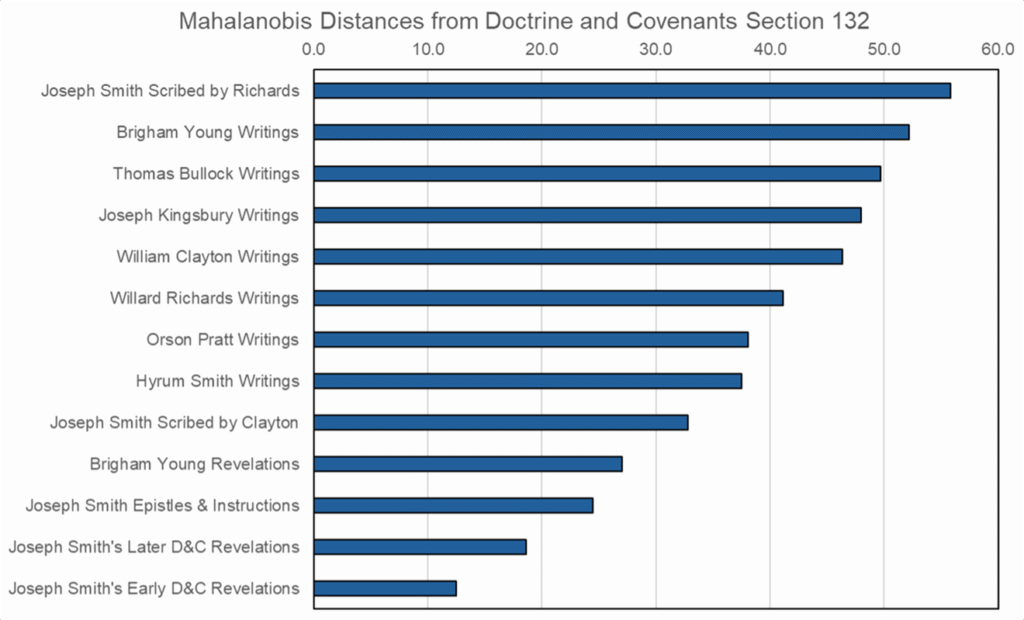
Figure 1. The dissimilarity from Doctrine and Covenants 132 of all sets of comparison texts measured by Mahalanobis distance. The texts closest in similarity to section 132 are Joseph Smith’s revelatory sections. The other comparison texts are increasingly farther away and thus increasingly dissimilar.
It is clearly evident in figure 1 that the revelatory sections of Joseph Smith from both the Kirtland and Nauvoo periods are the least dissimilar.115 Joseph Smith’s doctrinal epistles and instructions, his texts [Page 39]scribed by William Clayton, and Brigham Young’s revelatory texts are the next in dissimilarity, but they are nearly twice as far from section 132 as Joseph’s revelatory sections in the Doctrine and Covenants. The personal writings of all of the candidate authors are distinctly dissimilar to the text of section 132 because these texts are over two times and nearly three times farther from section 132 than Joseph Smith’s revelatory sections.
We now look more closely at the five sets of texts with the least dissimilarity from section 132: Joseph Smith’s early revelations; later revelations; and epistles and instructions; Brigham Young’s revelations; and Joseph Smith’s writings as scribed by William Clayton.
Figure 2 shows a three-dimensional graph with 99.9% confidence ellipsoids around the samples to display the results. The ellipsoids represent a volume within which it is reasonable to estimate the author’s style to 99.9% confidence. If the ellipsoids do not overlap, then it is unreasonable to claim they represent the same authorial style (the evidence indicates they are different styles). If the ellipsoids overlap, then there is insufficient evidence to indicate that the authorial styles are different (the styles are either the same or indistinguishably similar).
[Page 40]
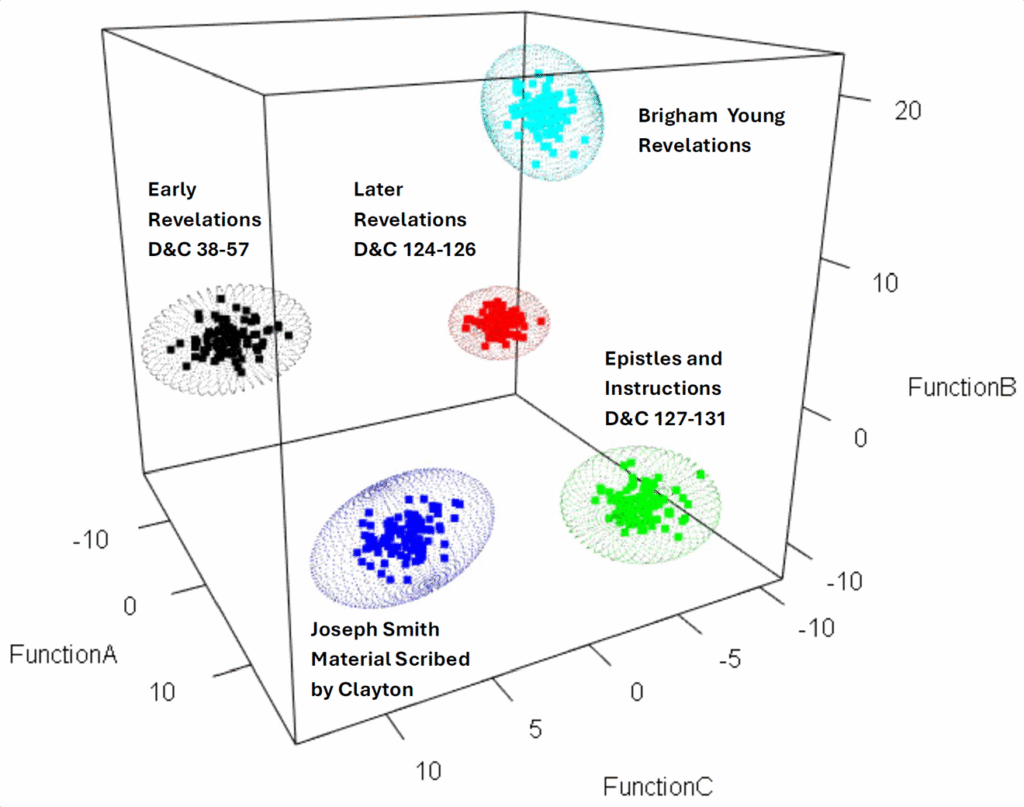
Figure 2. The five sets of comparison texts closest to section 132 separate distinctly from each other. All other comparison texts are far outside this cube and are thus not displayed. They are so far away as to not be in authorship contention.
Only the five sets of texts closest in style to section 132 are shown, since all the other data sets are so far away that they can be easily eliminated as displaying the same authorial style as section 132. The three dimensions (functions A, B, and C) are the three dimensions that are linear combinations of the grammatical words that measure the authorial distinctiveness of the candidate authors’ texts.
In figure 2, Function A is the linear combination of word frequencies that identifies the greatest distinction among all the data sets. Function A separates Joseph Smith’s early revelations in Doctrine and Covenants 38–57 (black) and later revelations in Doctrine and Covenants 124–126 (red) from his material scribed by William Clayton (blue) and his epistles and instructions in Doctrine and Covenants 127–131 (green).116
Function B is a different linear combination of word frequencies that identifies the next greatest distinction among the data sets. Function B [Page 41]clearly separates Brigham Young’s authorial style in his revelations (light blue) from Joseph Smith’s revelatory style.
Function C is the dimension with the next greatest distinction among the data sets and it separates Joseph Smith’s non-revelatory texts as scribed by Clayton (blue) from Joseph’s epistles and instructions as recorded in the Doctrine and Covenants (green).
To more fully show the distinctions in authorial style, we present another view of the results in figure 3 by rotating the three-dimensional display about 45⁰ counterclockwise. We present another view of the results in figure 4 after rotating the three-dimensional display 90⁰ counterclockwise again.
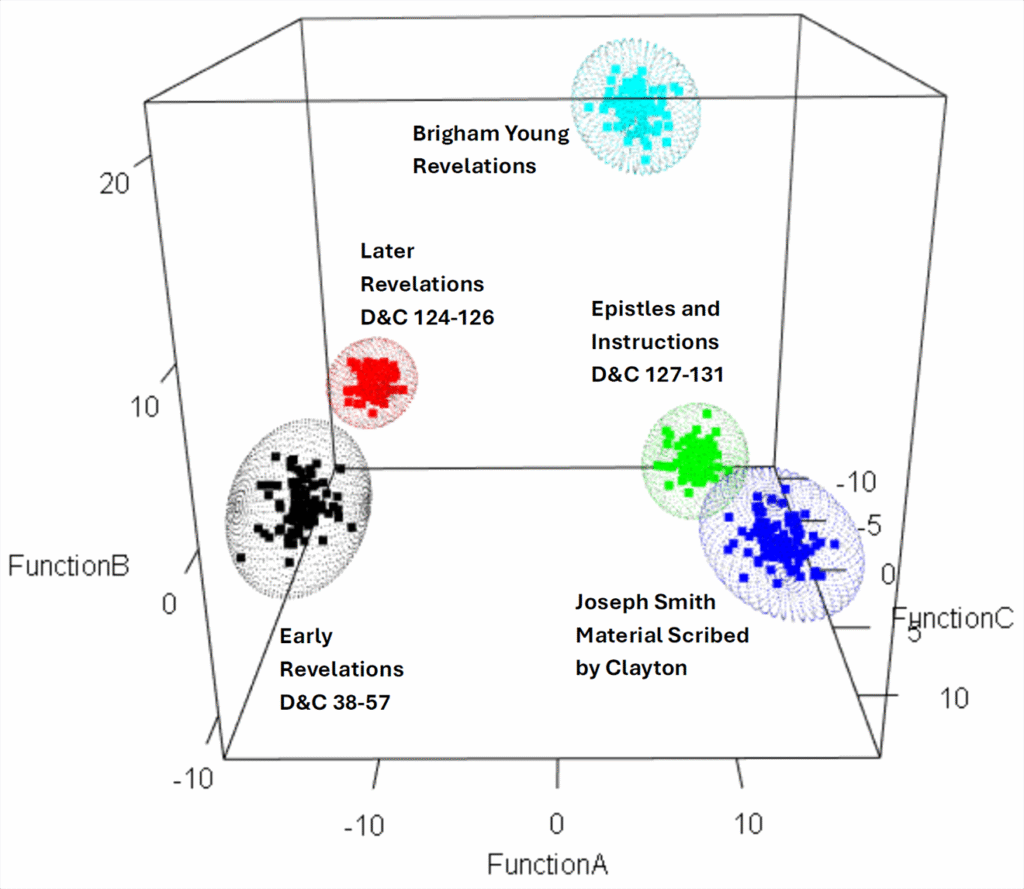
Figure 3. Function A separates Joseph’s early and later revelations at the bottom left (black and red) from his material scribed by Clayton and his epistles and instructions at the bottom right (blue and green). Function B separates Brigham’s revelations at the top (light blue) from Joseph’s texts at the bottom.
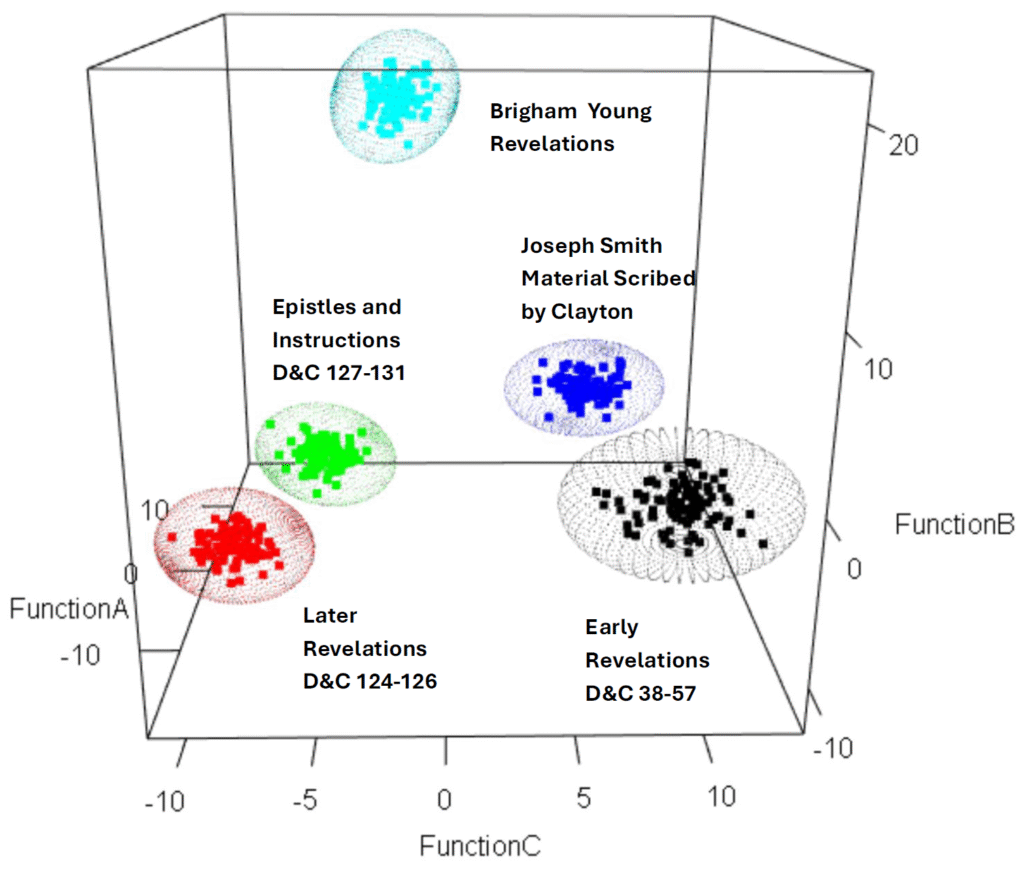
Figure 4. Function C separates the early revelatory sections (black) at the front right from the later revelatory sections at the front left (red).
The question is: Using the same linear combinations of function word frequencies for the two parts of section 132 (the non-plural marriage portion and the plural marriage portion), where will they be compared to these five data sets? Also, will the two parts of section 132 be near each other or far apart? Will the plural marriage portion be near Brigham Young or near Joseph’s early or later revelations? Will it be near Joseph’s material as scribed by Clayton, near the epistles and instructions, or not close to any of these?
[Page 42]Figure 5 shows where the two parts of section 132 are among the five sets from the same viewpoint as in figure 2. The two parts of section 132 are closest to each other (shown in brown and purple), and they are both close to the early Doctrine and Covenants revelatory [Page 43]sections (shown in black). SDA classifies 100% of the samples from both parts of section 132 to the early revelations. They are both next closest to the later Doctrine and Covenants revelatory sections (red). They are not at all close to Joseph’s other materials (dark blue and green), which are also later in time and of a different genre. They are far from Brigham Young (light blue) or anyone else considered, all of whom are so far away that they are outside the cube.
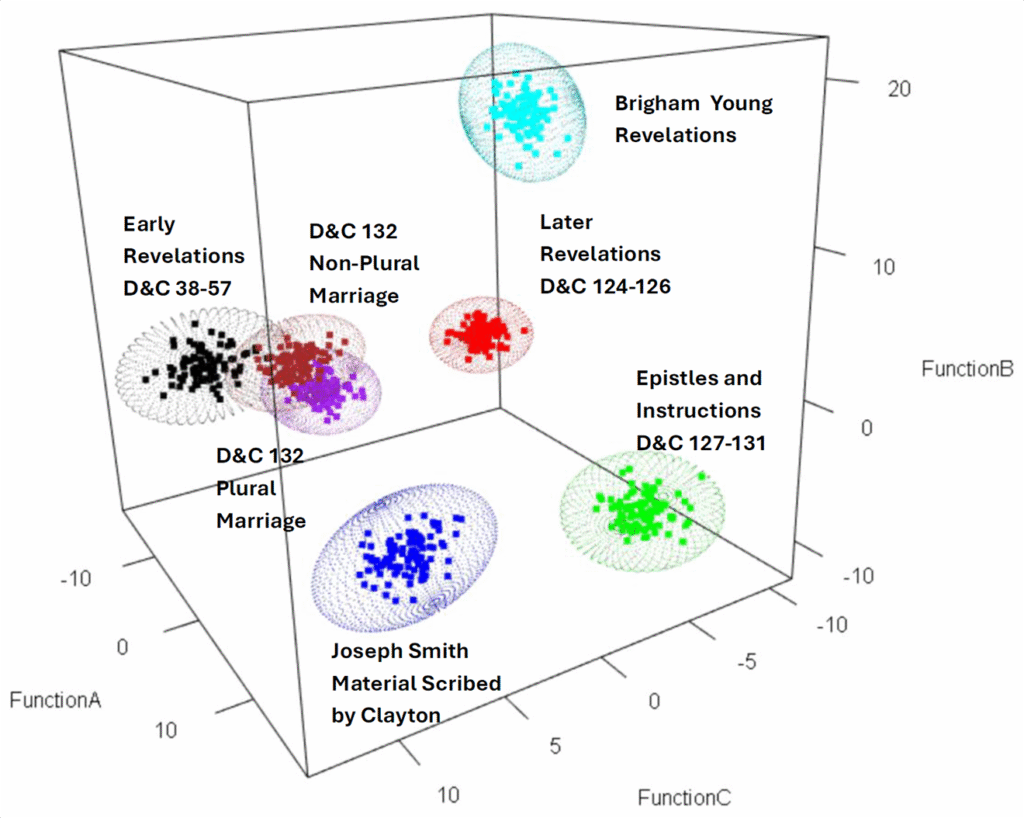
Figure 5. The two parts of section 132 (brown and purple) plotted among the five closest candidate sets. The two parts are nearest to the early revelations (black).
Figures 6 and 7 display rotations of the cube to further indicate the distinctions among the texts. It is evident that the two parts of section 132 clearly group with Joseph’s texts (at the bottom of the display) and are far from Brigham’s revelations (at the top).
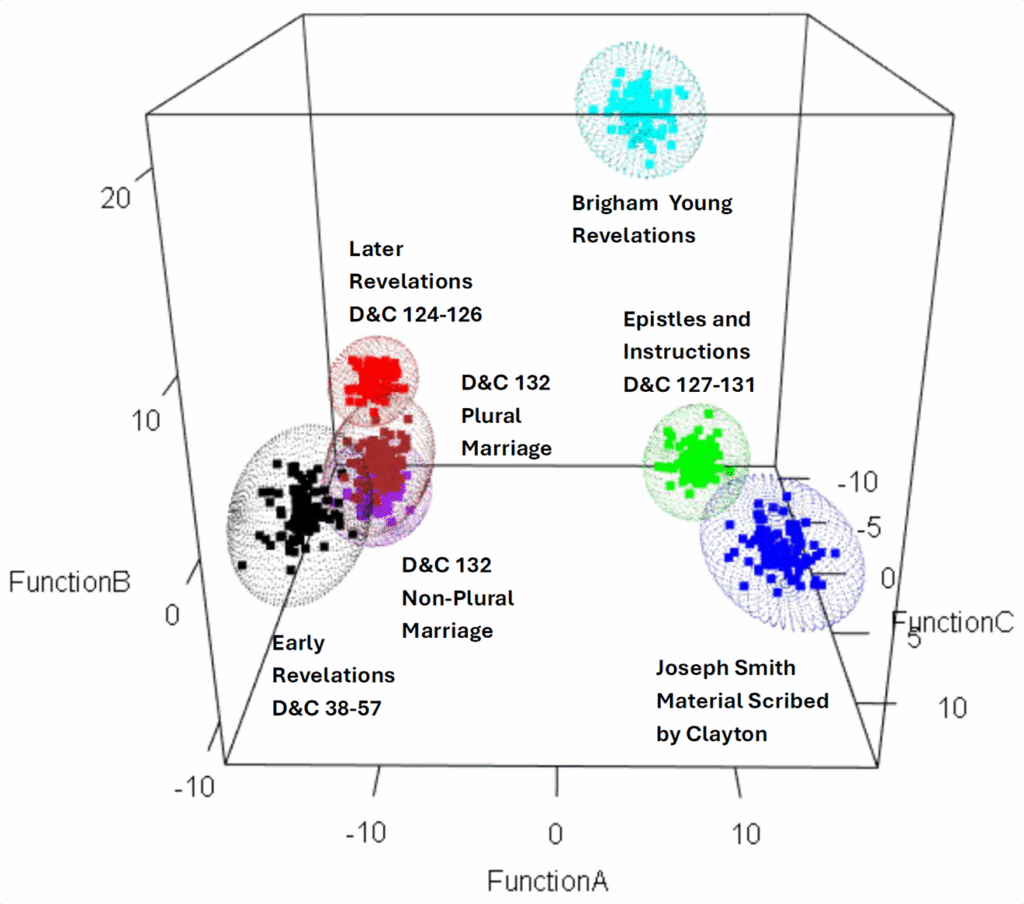
Figure 6. Function A shows that the two parts of section 132 (shown in brown and purple) are near the early and late revelations at the bottom left (shown in black and red) and that they are distinct from Joseph Smith’s other revelatory material at the bottom right (shown in blue and green). Function B shows that the two parts of section 132 are far from Brigham’s revelations at the top (shown in light blue).
[Page 44]
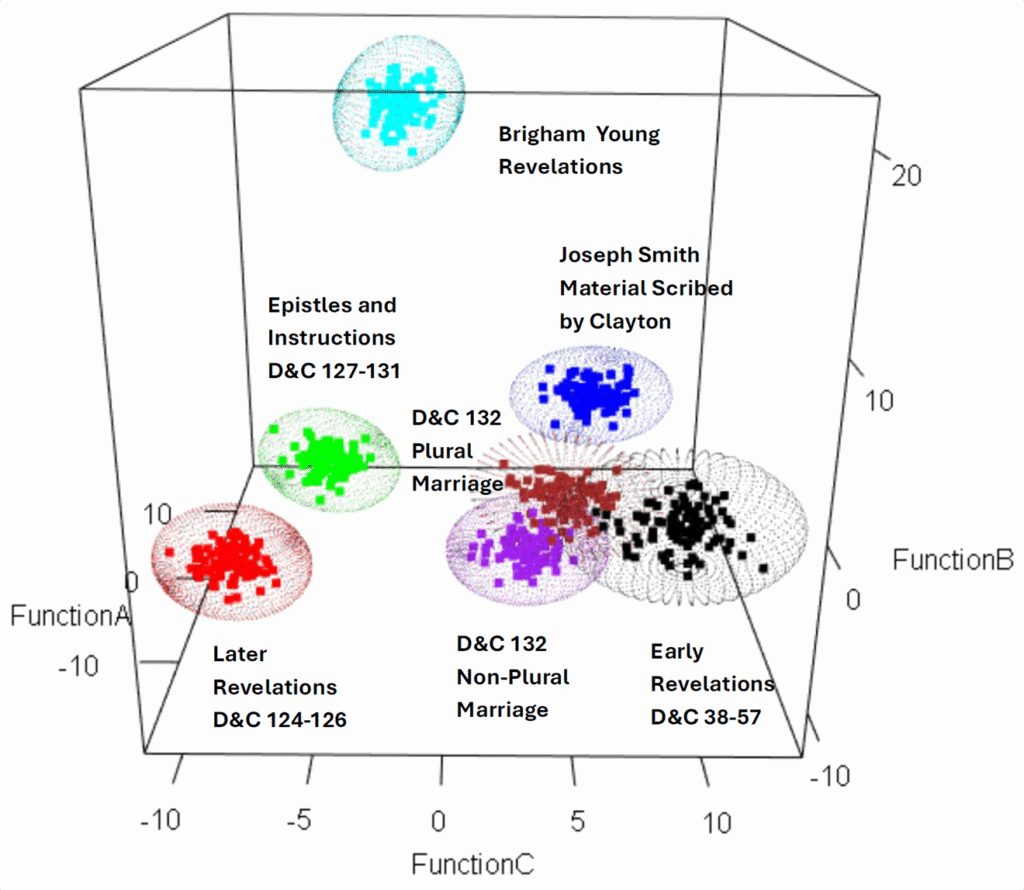
Figure 7. Function C shows that the two parts of section 132 (shown in brown and purple) overlap with the early revelations at the front right (shown in black) and separate from the later revelations at the front left (shown in red).
Figure 8 zooms in on the two parts of section 132 and the early revelations. It is evidence that the plural marriage and non-plural marriage parts of section 132 are not meaningfully distinct from each other, and they are not meaningfully distinct from the early revelatory sections.
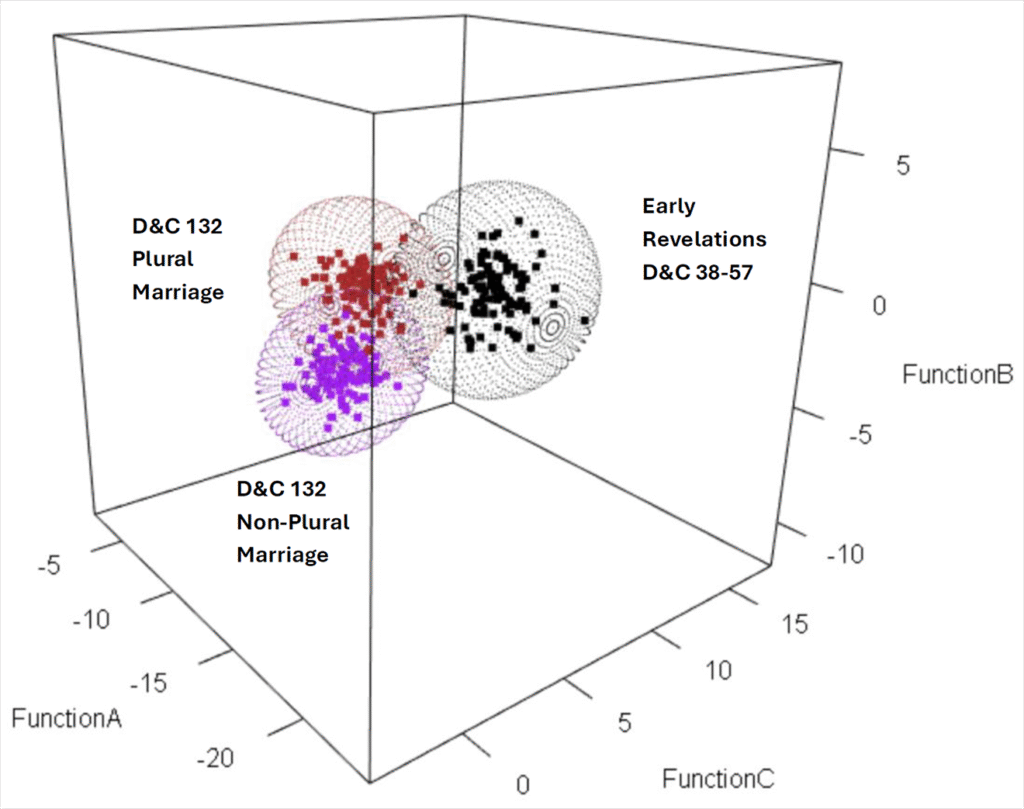
Figure 8. Zooming in on the two parts of section 132 (shown in brown and purple) and the early revelatory sections (shown in black), the three 99.9% confidence ellipsoids overlap and are not meaningfully distinctive.
To show more fully the distinctions in authorial style, we present three more views of these sets by rotating the cube display. Figure 9 shows the front view, figure 10 a top view, and figure 11 shows a [Page 46]side view. In all three displays, we can see considerable overlap of the revelatory texts. No matter how one looks at the results, the plural marriage and non-plural marriage parts are not meaningfully distinguishable from each other and they group closely with the early revelatory sections.
[Page 45]
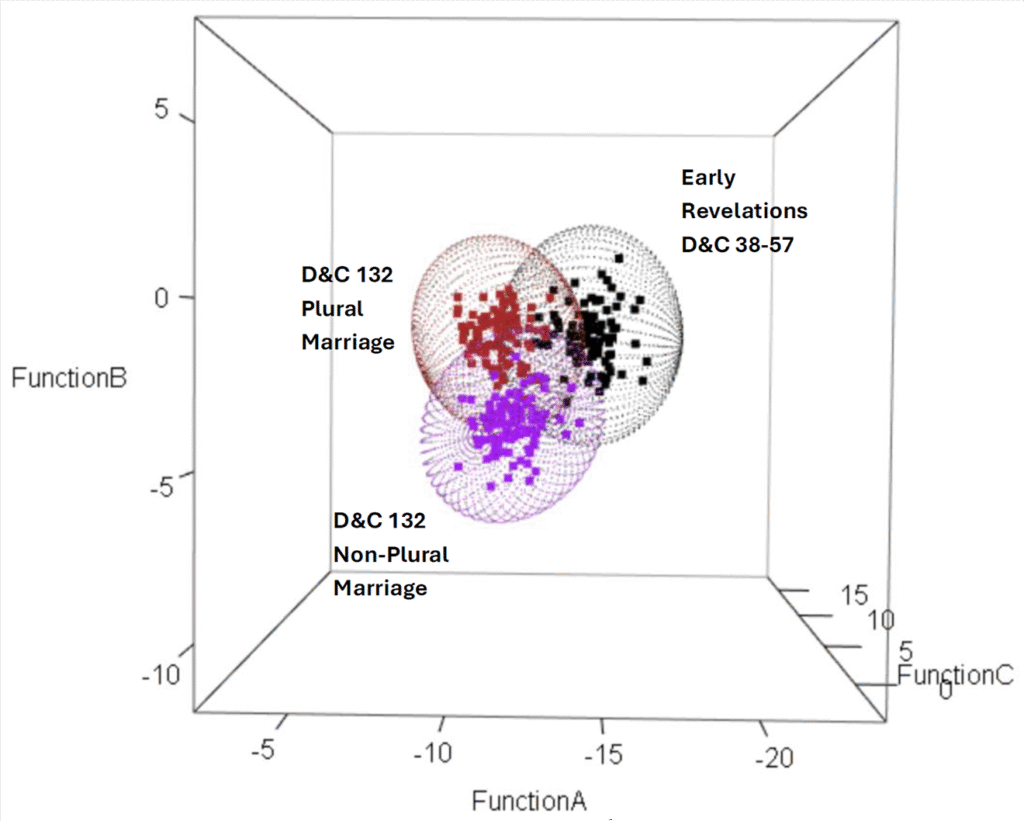
Figure 9. Front view showing that the plural marriage and non-plural marriage parts of section 132 (brown and purple) overlay with the early revelations (black).
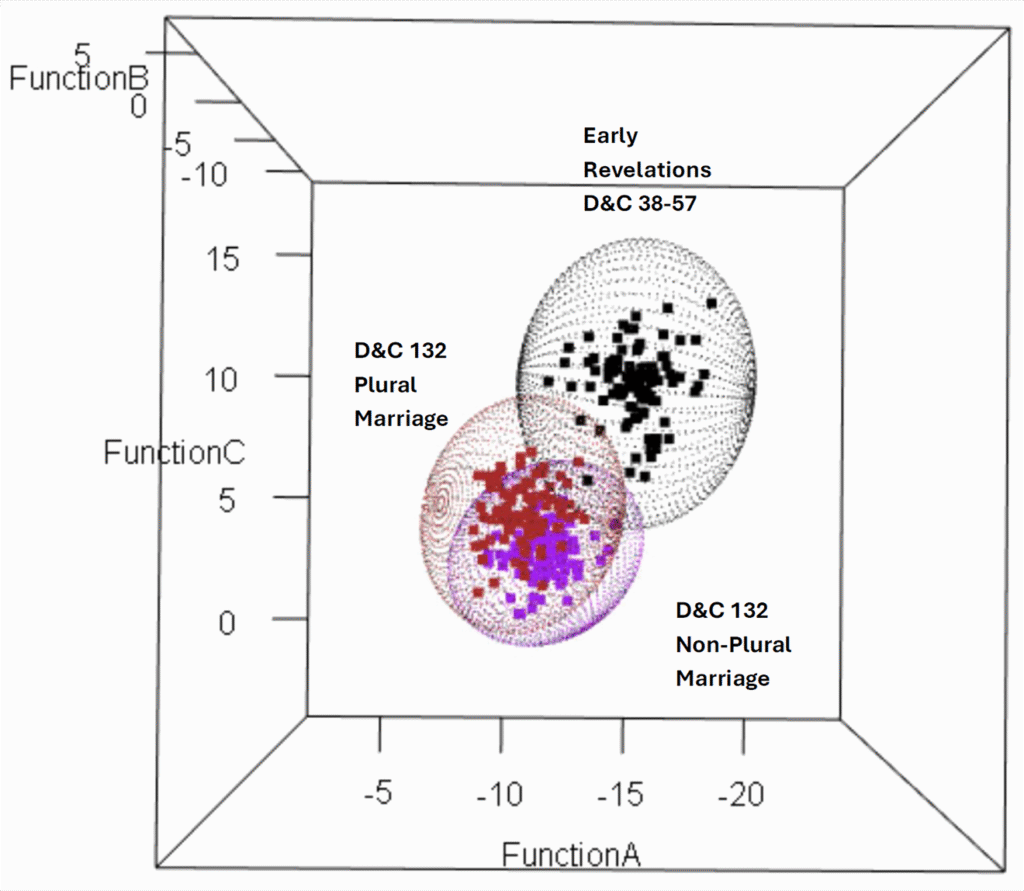
Figure 10. Top view showing considerable overlap of the two parts of section 132 (brown and purple) with each other and with the early revelations (black).
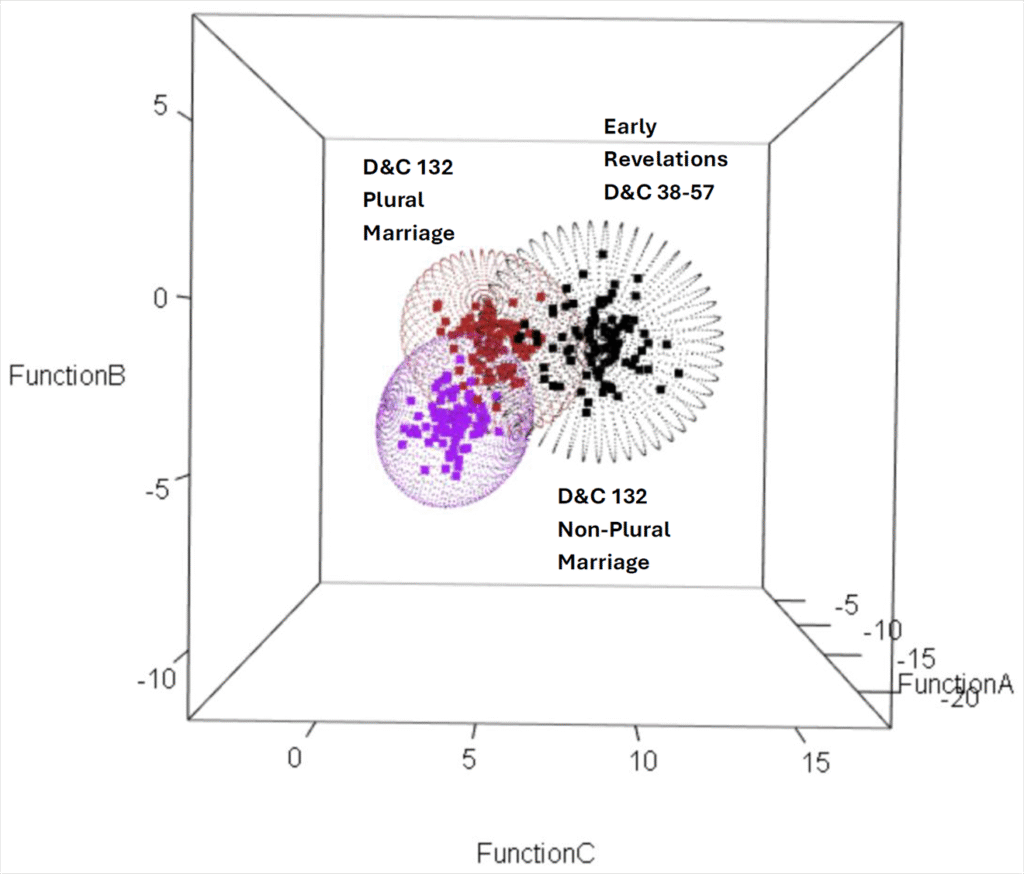
Figure 11. Right side view showing that the ellipsoids of all three data sets overlap considerably.
Contrary to Richard and Pamela Price’s opinion as stated in Part One, the grammatical patterns in both parts of section 132 are similar to Joseph Smith’s word-use pattern and dissimilar from Brigham Young’s word-use pattern.
Based on the results of the analysis, we found no stylometric evidence contrary to the Church’s official declaration of the authorship of Doctrine and Covenants 132. If the revelation indeed originated in the early 1830s, then it should be congruent in style with other contemporaneous sections of the Doctrine and Covenants. This is what the results show. Further, we found no evidence of authorial style difference within the plural marriage and non-plural marriage texts of section 132, thus making remote the possibility of different authorship.
The results of the stylometric analyses can be viewed in even greater detail in an immersive, virtual reality, three-dimensional display at ldsstylometrics.org/DC132Authorship/.
[Page 47]Additional analyses are presented in appendix D. These analyses demonstrate the validity of the methodology used and they further corroborate the results. Finally, see appendix E for an in-depth critical evaluation of an unpublished but circulated analysis of section 132, conducted by Ethan Lloyd.
Conclusion of Part Three
Assertions contrary to Joseph’s authorship of section 132 are not congruent with the stylometric evidence. The stylometric evidence does not support the assertion that Brigham Young wrote section 132, either in part or as a whole. Further, stylometric evidence does not indicate that any of the other candidate authors provided the words for the revelation. The authorial styles of both parts of section 132 are not distinguishably different, and they both align with other relevant sections of the Doctrine and Covenants. The stylometric evidence is consistent with the Church’s claimed origin of the revelation.
Summary and Conclusions of This Study
The combined historical and stylometric evidence presented in this study strongly supports the long-standing claim that Doctrine and Covenants 132 originated with Joseph Smith and was dictated by him in July 1843, rather than being composed later by Brigham Young or any other potential author.
Multiple, independent, contemporary witnesses—both friendly and antagonistic to plural marriage, as well as those who remained in the Church and those who did not—consistently reported the existence, content, and public and private readings of the revelation during Joseph Smith’s lifetime. While no surviving diary entries in Joseph’s own hand replicate the wording of section 132, extensive first-hand reports by his scribes and close associates, taken during his Nauvoo-period sermons and instructions, document him teaching the same doctrines and using language closely aligned with the text of the revelation.
In addition, stylometric analysis shows that the linguistic features in section 132 are congruent with the Prophet’s other revelations in the Doctrine and Covenants, even as far back as 1831. Thus, the mutually supportive consistency of the historical records and statistical authorship analysis make highly implausible the alternative assertions for the authorship of section 132.
[Page 48]Appendix A: Tables of Testimonies and References to the Revelation on Marriage
Table 1. First-hand testimonies of Joseph Smith’s revelation on marriage in 1843 and 1844.
| Person | Event | Date | Document |
|---|---|---|---|
| William Clayton | Transcribed manuscript dictated by Joseph Smith | 12 July 1843 | Diary 12 July 1844 Letter 11 November 1871 Affidavit 1874 |
| Joseph C. Kingsbury | Made copy from Clayton manuscript | Mid July 1843 | Affidavit March 1870 Affidavit May 1886 Testimony 1892 |
| Horace Whitney | Made copy from Kingsbury manuscript | 14 March 1847 | Journal 14 March 1847 |
| Austin Cowles | Heard Hyrum Smith read revelation, “Plurality of wives” “David and Solomon” “marrying virgins” |
12 August 1843 | Affidavit May1844 Nauvoo Expositor |
| William Marks | Heard Hyrum Smith read revelation “doctrine of polygamy” |
12 August 1843 | RLDS First Presidency and Twelve minutes 1 May 1865 |
| Leonard Soby | Heard Hyrum Smith read revelation “Polygamy” Same as published |
12 August 1843 | Affidavit November 1883 Letter February 1886 Affidavit March 1886 |
| David Fullmer | Heard Hyrum Smith read revelation “Plurality of wives” “Celestial Marriage” Same as published |
12 August 1843 | Affidavit 1869 |
| Thomas Grover | Heard Hyrum Smith read revelation | 12 August 1843 | Affidavit 1869 |
| James Allred | Heard Hyrum Smith read revelation “Celestial Marriage” |
12 August 1843 | Affidavit 1869 |
| Aaron Johnson | Heard Hyrum Smith read revelation “Celestial Marriage” |
12 August 1843 | Affidavit 1869 |
| Mercy Rachel Fielding | Had manuscript at home for several days | After 12 August 1843 | Statement 31 July 1886 |
| [Page 49]Charles Lambert | Heard Clayton read revelation | 1843–June 1844 | Autobiography 1885 |
| Lucy Walker | Saw manuscript at Mansion House | 1843–June 1844 | Testimony 1892 |
| Malissa Lott | Shown manuscript by Joseph Smith | 1843–June 1844 | Testimony 1892 |
| Cyrus Wheelock | Heard revelation read | November 1843 | Testimony 1892 |
| William Law | Read revelation “Authorized . . . more wives than one at a time” “In this world and the world to come” |
Late 1843 | Affidavit May 1844 Nauvoo Expositor |
| Jane Law | Read revelation “Ten wives” Condemnation if rejected |
Late 1843 | Affidavit May1844 Nauvoo Expositor |
Table 2. Second-hand testimonies of Joseph Smith’s revelation on marriage in 1843 and 1844.
| Person | Event | Date | Document |
|---|---|---|---|
| Jacob Scott | Revelation | January 1844 | Letter 5 January 1844 |
| Ebenezer Robinson | Hyrum told him and his wife that he “heard the voice of the Lord give the revelation” on polygamy to Joseph Smith | November-December 1843 | Affidavit 1885 |
| Charles Smith | Hyrum Smith met with a group of elders and said Joseph Smith had given a revelation on “plurality of wives” | Winter 1843–1844 | St. George Stake Historical Record 26 November 1882 |
| Lyman Wight | “He said that he saw and heard read the revelation establishing plural marriage before Joseph Smith’s death.” | Before June 1844 | Gideon Carter Affidavit 27 February 1894 |
| James Leithead | Hyrum confirmed there had been a revelation and he had read it to the high council. | Summer 1843 | Deseret News 28 March 1904 |
[Page 50]Table 3. Doctrine and Covenants 132 verses on marriage referenced in Nauvoo.
| Verses | Source | Date |
|---|---|---|
| D&C 132:3–4 | William Clayton | 16 July 1843 |
| D&C 132:5 | Franklin D. Richards | 16 July 1843 |
| D&C 132:7–10 | Willard Richards Franklin D. Richards Howard Coray Levi Richards Jacob Scott Hyrum Smith |
21 May 1843 21 May, 16 July 1843 21 May 1843 16 July 1843 5 January 1844 April 1844 |
| D&C 132:15 | Hyrum Smith | April 1844 |
| D&C 132:16–17 | William Clayton Franklin D. Richards Jacob Scott Hyrum Smith |
16 May 1843 16 July 1843 5 January 1844 April 1844 |
| D&C 132:19 | William Clayton Charlotte Haven Jacob Scott Hyrum Smith |
16 May 1843 15 October 1843 5 January 1844 April 1844 |
| D&C 132:20 | Willard Richards | 11 June 1843 |
| D&C 132:22 | Franklin D. Richards | 16 July 1843 |
| D&C 132:24 | Wiliam Clayton | 27 August 1843 |
| D&C 132:26–27 | William Clayton Austin Cowles Nauvoo Expositor Preamble |
16 May 1843 4 May 1844 7 June 1844 |
| D&C 132:28 | William Clayton | 16 July 1843 |
| D&C 132:30 | William Clayton | 16 May 1843 |
| D&C 132:38–39 | Austin Cowles | 4 May 1843 |
| D&C 132:45–46 | Hyrum Smith | April 1844 |
| D&C 132:62–63 | Jane Law | 4 May 1844 |
| D&C 132:63 | Franklin D. Richards | 16 July 1843 |
| D&C 132:64–65 | Jane Law | 4 May 1844 |
Appendix B: Tables Comparing Doctrine and Covenants 132 with Other Historical Records
Bold text appearing in the tables in this appendix has been added for emphasis.
[Page 51]Table 4. Joseph Smith’s instruction 16 May 1843.
| Doctrine and Covenant 132 | William Clayton Journal 16 May 1843 |
|---|---|
| And again, verily, I say unto you, if a man marry a wife by my word, which is my law, and by the new and everlasting covenant . . . by him . . . unto whom I have appointed this power and the keys of the priesthood (132:19) | He said that except a man and his wife enter into an everlasting covenant and be married for eternity while in this probation by the power and authority of the Holy priesthood . . . Those who are married by the power and authority of the priesthood. |
| Therefore, when they are out of the world . . . They cannot be enlarged (132:16–17). | They will cease to increase when they die [they will not have any children in the resurrection]. |
| Which glory shall be a fulness and a continuation of the seeds forever and ever (132:19). As touching Abraham and his seed, out of the world they should continue; both in the world and out of the world should they continue as innumerable as the stars (132:30). |
Those who are married by the power and authority of the priesthood in this life and continue without committing the unpardonable sin against the Holy Ghost will continue to increase and have children in celestial glory. |
| Verily, verily, I say unto you, if a man marry a wife according to my word . . . and he or she shall commit any sin or transgression of the new and everlasting covenant whatever, and all manner of blasphemies, and if they commit no murder wherein they shed innocent blood, yet they shall come forth in the first resurrection, and enter into their exaltation; but they shall be destroyed in the flesh, and shall be delivered unto the buffetings of Satan unto the day of redemption, saith the Lord God. The blasphemy against the Holy Ghost, which shall not be forgiven in the world nor out of the world, is that ye commit murder wherein ye shed innocent blood, and assent unto my death, after ye have received my new and everlasting covenant, saith the Lord God; and he that abideth not this law can in nowise enter into my glory, but shall be damned, saith the Lord (132:26–27). | Those who are married by the power and authority of the priesthood in this life and continue without committing the sin against the Holy Ghost will continue to increase . . . The unpardonable sin is to shed innocent blood or be an accessory thereto. All other sins will be visited with judgement in the flesh and the spirit delivered to the buffetings of satan until the day of the Lord Jesus. |
Table 5. Joseph Smith’s discourse on 21 May 1843.
| Doctrine and Covenants 132 | Joseph Smith 21 May 1843 |
|---|---|
| All covenants, contracts, bonds, obligations, oaths, vows, performances, connections, associations, or expectations that are not made and entered into . . . for time and for all eternity are of no efficacy, virtue, or force, in and after the resurrection from the dead; for all contracts that are not made unto this end have an end when men are dead (132:7). | We have no claim in our eternal comfort in relation to Eternal things unless our actions & contracts & all things tend to this end (Willard Richards) Our covenants here are of no force one with another except made in view of eternity (Franklin D. Richards) That which is done by us that is not done with a view to eternity is not binding in eternity (Howard Coray) |
[Page 52]Table 6. Joseph Smith’s discourse on 11 June 1843.
| Doctrine and Covenants 132 | Joseph Smith 11 June 1843 |
|---|---|
| [Those who do not receive the New and Everlasting covenant of marriage] are not gods, but are angels of God forever and ever (132:17). Ye shall come forth in the resurrection . . . Then shall they be gods, because they have no end; therefore shall they be from everlasting to everlasting, because they continue; then shall they be above all, because all things are subject unto them. Then shall they be gods, because they have all power, and the angels are subject unto them (132:19–20). |
Gods have ascendancy over the angels angels remain angels.—some are resurrected to become gods by such revelations as god gives in the most holy place.—in his temple. |
Table 7. Joseph Smith‘s discourse on 16 July 1843.
| Doctrine and Covenants 132 | Joseph Smith 16 July 1843 |
|---|---|
| For all who will have a blessing at my hands shall abide by the law which was appointed for that blessing, and the conditions thereof, as were instituted from before the foundation of the world (132:5). | All Blessings that were ordained for man by the Council of Heaven were on conditions of obedience to the Law thereof. (Franklin D. Richards, “Scriptural Items” 16 July 1843) |
| And verily I say unto you, that the conditions of this law are these: All covenants, contracts, bonds, obligations, oaths, vows, performances, connections, associations, or expectations, that are not made and entered into and sealed by the Holy Spirit of promise, of him who is anointed, both as well for time and for all eternity, and that too most holy, by revelation and commandment through the medium of mine anointed, whom I have appointed on the earth to hold this power . . . are of no efficacy, virtue, or force in and after the resurrection from the dead; for all contracts that are not made unto this end have an end when men are dead (132:7). | No man can obtain a Blessing unless the contract or covenant be made in view of eternity. All contracts in view of this Life only terminate with this Life. (Franklin D. Richards, “Scriptural Items” 16 July 1843). P.M. spoke of contracts & covenants made from life end with life. The necessity of the Temple that the Servants of God may be sealed in their foreheads. (Levi Richards Journal, 16 July 1843). |
| Therefore, when they are out of the world they neither marry nor are given in marriage; but are appointed angels in heaven, which angels are ministering servants, to minister for those who are worthy of a far more, and exceeding, and eternal weight of glory. For these angels did not abide my law; therefore they cannot be enlarged, but remain separately and singly, without exaltation in their saved condition, to all eternity; and are angels of God forever and ever (132:16–17). | Case of the woman & 7 husbands Luke 20–29 &c. [“neither marry, nor are given in marriage” Luke 20:35]. Those who keep no eternal law in this life or make no eternal contract are single & alone in the eternal world (Luke 20–35) and are only made Angels to minister to those who shall be heirs of Salvation never becoming Sons of God having never kept the Law of God i.e., eternal Law. (Franklin D. Richards, “Scriptural Items” 16 July 1843). |
| [Page 53]For all who have this law revealed unto them must obey the same. For behold, I reveal unto you a new and everlasting covenant (132:3–4). And again, verily I say unto you, if a man marry a wife by my word, which is my law, and by the new and everlasting covenant (132:19). “Law of my Holy Priesthood” (132:28). |
P. M. went to the Grove and heard pres. J. preach on the law of the priesthood . . . He showed that a man must enter into an everlasting covenant with his wife in this world or he will have no claim on her in the next. He said that he could not reveal the fulness of these things until the Temple is completed (William Clayton Journal, 16 July 1843) |
Table 8. Hyrum Smith’s discourse April 1844.
| Doctrine and Covenants 132 | Hyrum Smith 8 April 1844 |
|---|---|
| And verily I say unto you, that the conditions of this law are these: All covenants, contracts, bonds, obligations, oaths, vows, performances, connections, associations, or expectations, that are not made and entered into and sealed by the Holy Spirit of promise, of him who is anointed, both as well for time and for all eternity, and that too most holy, by revelation and commandment through the medium of mine anointed, whom I have appointed on the earth to hold this power (and I have appointed unto my servant Joseph to hold this power in the last days, and there is never but one on the earth at a time on whom this power and the keys of this priesthood are conferred), are of no efficacy, virtue, or force in and after the resurrection from the dead; for all contracts that are not made unto this end have an end when men are dead (132:7). Shall be of full force when they are out of the world (132:19) |
The idea of marrying for eternity is the seal of the covenant, and is easily understood and as to speaking of it, I could make all the world believe it, for it is noble and grand; it is necessary in consequence of the broken covenants in the world . . . When I look at the seal of the new covenant and reflect that all the covenants made by the authority of man are only made to be of force during the natural life and end there. I rejoice that what is done by the Lord has an endless duration. No marriage is valid in the morn of the resurrection unless the marriage covenant be sealed on earth by one having the keys and power from the Almighty God to seal on earth, and it shall be bound in heaven. Such a sealing will have full effect in the morn of the resurrection . . . The Lord has given Joseph the power to seal on earth and in heaven [for] those who are found worthy having the spirit of Elijah and Elias, he has power to seal with a seal that shall never be broken, and it shall be of force in the morn of the resurrection. |
| Behold, mine house is a house of order, saith the Lord God, and not a house of confusion. Will I accept an offering, saith the Lord, that is not made in my name? Or will I receive at your hands that which I have not appointed? (132:8–10). [Authorized sealings are only done by revelation and “commandment” under the direction of the Lord’s authorized servant who holds that power (132:7).] |
I wish the Elders to understand it is lawful for a man to marry a wife, but it is unlawful to have more, and God has not commanded any of you to have more. |
| [Page 54]If man marry a wife by my word, which is my law, and by the new and everlasting covenant, and it is sealed by the Holy Spirit of promise . . . [for] time and through all eternity” (132:19). | The idea of marrying for eternity is the seal of the covenant. When I look at the seal of the new covenant. |
| And verily I say unto you, that the conditions of this law are these: All covenants, contracts, bonds, obligations, oaths, vows, performances, connections, associations, or expectations, that are not made and entered into and sealed by the Holy Spirit of promise, of him who is anointed, both as well for time and for all eternity, and that too most holy, by revelation and commandment through the medium of mine anointed, whom I have appointed on the earth to hold this power . . . are of no efficacy, virtue, or force in and after the resurrection from the dead; for all contracts that are not made unto this end have an end when men are dead (132:7). [Unauthorized marriages] are not of force when they are dead (132:15). |
When I look at the seal of the new covenant and reflect that all the covenants made by the authority of man are only made to be of force during the natural life and end there. |
| Therefore, if a man marry him a wife in the world, and he marry her not by me nor by my word, and he covenant with her so long as he is in the world and she with him, their covenant and marriage are not of force when they are dead, and when they are out of the world; therefore, they are not bound by any law when they are out of the world. Therefore, when they are out of the world they neither marry nor are given in marriage; but are appointed angels in heaven. . . . But remain separately and singly, without exaltation (132:15–16). If a man marry a wife by my word, which is my law, and by the new and everlasting covenant, and it is sealed unto them by the Holy Spirit of promise, by him who is anointed, unto whom I have appointed this power, and the keys of this priesthood . . . it shall be done unto them, in time and throughout all eternity (132:19). |
I married me a wife, and I am the only one who had any right to her. We have five children, the covenant was made for our lives. She fell into the grave before God showed us his order. God has shown me that the covenant is dead, and had no force, neither could I have her in the resurrection, but we should be as the angels—it troubled me. President Joseph said you can have her sealed to you on the same principles as you can be baptized for the dead. I enquired what can I do for any second wife? You can also make a covenant with her for eternity and have her sealed to you by the authority of the priesthood. I named the subject to my present wife, and she said, “I will act as proxy for your wife that is dead, and I will be sealed to you for eternity myself for I never had any other husband. I love you and I do not want to be separate from you nor be forever alone in the world to come.” . . . What honest man or woman can find fault with such a doctrine as this? None.117 |
| [Page 55]And I have appointed unto my servant Joseph to hold this power in the last days, and there is never but one on the earth at a time on whom this power and the keys of this priesthood are conferred (132:7). For I have conferred upon you the keys and power of this priesthood. . . And verily, verily, I say unto you, that whatsoever you seal on earth shall be sealed in heaven; and whatsoever you bind on earth, in my name and by my word, saith the Lord, it shall be eternally bound in the heavens (132:45–46). Authorized sealings continue in the “resurrection” (132:19). |
I rejoice that what is done by the Lord has an endless duration. No marriage is valid in the morn of the resurrection unless the marriage covenant be sealed on earth by one having the keys and power from the Almighty God to seal on earth, and it shall be bound in heaven. Such a sealing will have full effect in the morn of the resurrection. . . . The Lord has given Joseph the power to seal on earth and in heaven [for] those who are found worthy having the spirit of Elijah and Elias, he has power to seal with a seal that shall never be broken, and it shall be of force in the morn of the resurrection. |
| Those who are worthy of a far more, and exceeding, and eternal weight of glory (132:16). They shall pass by the angels, and the gods which are set there, to their exaltation and glory in all things, as hath been sealed upon their heads, which glory shall be a continuation of the seeds forever, and ever. Then shall they be gods, because they have no end; therefore, shall they be from everlasting to everlasting, because they continue (132:19–20). |
We will come up in the morn of the resurrection; and every soul that is saved will receive an eternal increase of glory. |
Table 9. David and Uriah.
| Doctrine and Covenants 132 | Opponents of Plural Marriage |
|---|---|
| David also received many wives and concubines, and also Solomon . . . and in nothing did they sin save in those things which they received not of me. David’s wives and concubines were given unto him by the hand of Nathan, my servant, and others of the prophets who had the keys of this power; and in none of these things did he sin against me save in the case of Uriah and his wife (132:38–39). |
In the latter part of the summer, 1843, the Patriarch Hyrum Smith, did in the High Council, of which I was a member, introduce what he said was a revelation given through the Prophet; that the said Hyrum Smith did essay to read the said revelation in the said Council, that according to his reading there was contained the following doctrines; . . . that “David and Solomon had many wives, yet they sinned not save in the matter of Uriah” (Austin Cowles Affidavit, 4 May 1844, Nauvoo Expositor). Joseph taught that David did not sin in having many wives, only in the case of Uriah (Samuel Bennett, Messenger and Advocate, 1 November 1844). There is a certain feature embodied in that revelation to which I invite the attention of every honest man and woman. It is this:–David did not sin in the case of Uriah, save in the death of Uriah. And Hyrum Smith did say—this I can prove from the best testimony—that Solomon did not sin in having many wives and concubines, but that his sin consisted in worshipping their heathen Gods. (J. Gibson Divine, Messenger and Advocate, 15 March 1845). |
[Page 56]Table 10. Sealing up unto eternal life.
| Doctrine and Covenants 132 | Opponents of Plural Marriage |
|---|---|
| Verily, verily, I say unto you, if a man marry a wife according to my word, and they are sealed by the Holy Spirit of promise, according to mine appointment, and he or she shall commit any sin or transgression of the new and everlasting covenant whatever, and all manner of blasphemies, and if they commit no murder wherein they shed innocent blood, yet they shall come forth in the first resurrection, and enter into their exaltation; but they shall be destroyed in the flesh, and shall be delivered unto the buffetings of Satan unto the day of redemption, saith the Lord God. The blasphemy against the Holy Ghost, which shall not be forgiven in the world nor out of the world, is that ye commit murder wherein ye shed innocent blood, and assent unto my death, after ye have received my new and everlasting covenant, saith the Lord God; and he that abideth not this law can in nowise enter into my glory, but shall be damned, saith the Lord (132:26–27). | [The revelation on plurality of wives which Hyrum Smith read to the high council in the Summer of 1843 taught] the sealing up of persons to eternal life, against all sins, save the shedding of innocent blood or of consenting thereto (Austin Cowles Affidavit, 4 May 1844). Inasmuch as they have introduced false and damnable doctrines into the Church, such as . . . the doctrine of unconditional sealing up to eternal life, against all crimes except the shedding of innocent blood. (“Preamble” Nauvoo Expositor, 7 June 1844). |
Table 11. The number of plural wives.
| Doctrine and Covenants 132 | Opponents of Plural Marriage |
|---|---|
| And if he have ten virgins given unto him by this law | It authorized some to have the number of ten (Jane Law Affidavit, 4 May 1844, Nauvoo Expositor). He taught the doctrine that a man could have ten wives (Samuel Bennett, Messenger and Advocate, 1 November 1844) According to this revelation every high priest is entitled to the number of ten wives (J. Gibson Divine, Messenger and Advocate, 5 March 1845). |
Table 12. Warnings in the revelation.
| Doctrine and Covenants 132 | Opponents of Plural Marriage |
|---|---|
| And again, verily, verily, I say unto you, if any man have a wife, who holds the keys of this power, and he teaches unto her the law of my priesthood, as pertaining to these things, then shall she believe and administer unto him, or . . . she then becomes the transgressor (132:64–65) | [The revelation] set forth that those women who would not allow their husbands to have more wives than one should be under condemnation before God. (Jane Law Affidavit, 4 May 1844, Nauvoo Expositor). |
[Page 57]Appendix C: Documents Used in the Stylometric Analysis
Hyrum Smith
- Diary or Journal of 1832–1833118
- Letter to Hannah Grinnels and children, 16 March 1839119
- Letter to Thomas H. Owen, Esq., 4 June 1844120
- Writings, approximately 1844121
Joseph Smith
The revelations of Joseph Smith are divided into three periods. See The Joseph Smith Papers for source documents to all Doctrine and Covenants sections used in the stylometric analysis.122
Early Doctrine and Covenants revelatory sections
- Doctrine and Covenants 38–57; January to July 1831
Doctrine and Covenants revelatory sections from Nauvoo period
- Doctrine and Covenants 124; 19 January 1841
- Doctrine and Covenants 125; Early March 1841
- Doctrine and Covenants 126; 9 July 1841
Doctrine and Covenants epistles and instructions from Nauvoo period
- Doctrine and Covenants 127; 1 September 1842 (epistle)
- Doctrine and Covenants 128; 7 September 1842 (epistle)
- Doctrine and Covenants 129; 9 February 1843 (instructions)
- Doctrine and Covenants 130; 2 April 1843 (instructions)
- [Page 58]Doctrine and Covenants 131; 16 May 1843 (instructions) and 17 May 1843 (discourse)
William Clayton
There are two categories for the writings of William Clayton used in the stylometric analysis.
William Clayton as scribe for Joseph
- Letter to Jennetta Richards, 23 June 1842123
- Letter to Emma Smith, 16 August 1842124
- Letter to Wilson Law, 16 August 1842125
- Journal Entries, 16 August; 23 August 1842126
- Letter to James Arlington Bennett, 8 September 1842127
- Letter to Joseph L. Heywood, 13 February 1844128
- Letter to John Smith, 17 June 1844129
William Clayton’s writing
- Letter “To the Saints in England,” 10 December 1840130
- [Page 59]Diary (1840–1842)131
- Diary (1 December 1842–12 July 1843)132
- Letter, 16 May 1844133
- “History of the Nauvoo Temple,” ca. 1845134
Joseph Kingsbury
- History of Joseph Corrodon Kingsbury Copied from his own handwriting in his little books where he kept his diary by his grand-daughter Rosalie Meservy Watson as written by his own hand 1846, 1847, 1849, 1850, and later.135
Willard Richards
There are two categories for the writings of Willard Richards used in the stylometric analysis.
Willard Richards as scribe for Joseph
- Letter to Sidney Rigdon, 27 March 1843136
- Letter to Col. Isaac Morley, 16 June 1844137
- Letter to Emma Smith, 23 June 1844138
- Letter to Thomas Ford, 23 June1844139
- [Page 60]Letter to Thomas Ford, 24 June 1844140
- Letter to Jesse B. Thomas, 26 June 1844141
- Letter to Thomas Ford, 26 June 1844142
- Letter to Emma Smith, 27 June 1844143
- Letter to Orville H. Browning, 27 June 1844144
Willard Richards’s writing
- Journal and biographical sketch (1836–1839)145
- Letter to Brigham Young, 15 June 1840146
- Letter to Llewellen Mantle, 16 April 1841147
- Letter to James Arlington Bennet, 15 December 1842148
- Letter to Orson Hyde, 26 May 1844149
- Letter to J.A. Bennett, 20 June 1844150
- [Page 61]Article “Two Minutes in Jail,” 27 June 1844151
- Letter to Brigham Young, 30 June 1844152
Thomas Bullock
- Journal, 31 August 1845 to 5 July 1846153
Brigham Young
There are two categories for the writings of Brigham Young used in the stylometric analysis.
Brigham Young’s writing
- Letter to Joseph Smith, 7 May 1840154
- Letter to Willard Richards, 17 June 1840155
- Letter to Mary Ann Young, 16–30 October 1840156
Brigham Young’s revelations
- Revelation for Reuben Miller, 30 January 1846157
- Word and Will of the Lord, Doctrine and Covenants 136, 14 January 1847158
- [Page 62]Dream, Brigham Young office files, 17 February 1847159
Orson Pratt
Possible candidates not used and reasons why
- Robert B. Thompson: Though he was one of Joseph’s scribes and the version of Doctrine and Covenants 124 we are using is in his handwriting, he died on 27 August 1841. So, he was not living when Doctrine and Covenants 132 was first recorded in 1843.
- Newell K. Whitney: He was in Nauvoo and sometime between 12–14 July 1843 he asked Joseph if he could have a copy of the revelation. After receiving permission, he had his clerk, Kingsbury, make a copy. However, Whitney is an unlikely candidate since Kingsbury stated that in the transcription process Whitney had simply verified that Kingsbury’s copy correctly matched the original manuscript after Kingsbury read his copy out loud to Whitney.
- Horace Whitney: He was Newell K. Whitney’s son, and made two copies of the Kingsbury document in 1847, but he cannot be considered a viable candidate for authorship of the original revelation, nor parts of it.
We also did not include other polygamists and Church leaders that have no specific connection to Doctrine and Covenants 132.
Appendix D: Additional Analyses
Validation studies
We performed additional analyses to test the validity of our procedure [Page 63]before conducting the actual analysis of the textual data. We included in the set of candidate authors two authors who we knew should be ruled out as authors of section 132 (called negative controls). One was Parley P. Pratt who contributed to many early Church documents, but who had no known connection to the origin of section 132. As expected—if the analysis methodology is accurate—the result showed that his authorial style was distinctly different from that in section 132. The other negative control was James J. Strang. Using his own writings and claimed revelations, his authorial style was easily seen as incongruent with section 132 texts, as expected for someone who is not a potential author. Interestingly, Strang’s revelations are closer than Brigham Young’s revelations to the section 132 texts, which provides further evidence against Brigham Young as the author of section 132.
Another validating analysis was to test the power of our procedure to detect even small textual differences that we knew existed (called positive controls). We determined the sample size and number of resamples, so that the results were stable, and we detected the known positive controls.
Additionally, some people have suggested that the counsel to Emma Smith in Doctrine and Covenants 132:51–56 belongs with the plural marriage verses. Therefore, we included these verses in the plural marriage verses and found that doing so did not change any of the analysis results.
Corroborating study
To corroborate our results, we used multivariate hierarchical cluster analysis, which is a classification technique that groups into clusters each data point, in sets of data, so that each point is in a cluster containing the most similar data points, and the clusters are separated by their dissimilarity. This procedure classified 700 data points, each representing one of the samples of words randomly drawn from the seven groups of texts. Cluster analysis correctly classified 99% of the data points into their respective groups. It connected the groups that are closest to each other and then the groups that are the next closest, and so on, until all the groups were connected.
Figure 12 displays a dendrogram of the clusters. The horizontal axis is the relative distance the clusters are from each other. The longer a horizontal line is that connects clusters, the more distant (or dissimilar) the clusters are from each other. Figure 12 shows that [Page 64]the plural marriage and non-plural marriage portions of section 132 cluster together tightly, and they form a group with the early revelatory sections. The later revelatory sections then join with that group, even though they are somewhat dissimilar. Joseph Smith’s epistles and instructions and his materials scribed by William Clayton cluster together, and they are separate from the revelatory sections. Next, Brigham Young’s revelations link with Joseph Smith’s non-revelatory cluster, but are highly dissimilar.
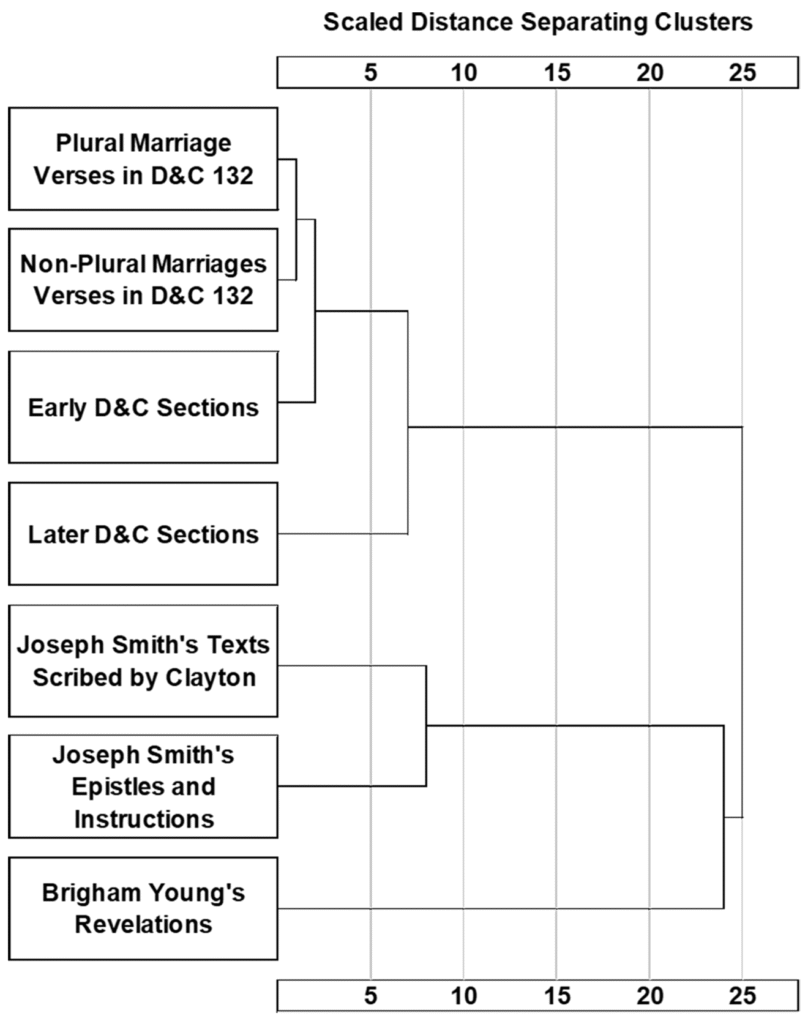
Figure 12. Hierarchical cluster analysis of the five groups of text closest to section 132. The revelatory sections group together. Joseph Smith’s epistles and instructions group with his material scribed by William Clayton. Brigham Young’s revelations are dissimilar from all the other texts.
The cluster analysis confirms the results presented in Part Three: that the plural marriage and non-plural marriage portions of section 132 are similar to each other and together they are closely similar to the early revelation sections, while Brigham Young’s revelations are highly dissimilar.
[Page 65]Appendix E: Examination of Ethan Lloyd’s Analysis
Ethan Lloyd, a statistics student, recently performed a stylometric analysis of Doctrine and Covenants 132 that has been circulated among some members of the Church.162 Although it appears sophisticated, unfortunately Lloyd’s analysis is not statistically valid, and his claims are misleading.
Lloyd randomly chose sections from the Doctrine and Covenants and counted the twenty-five most frequent words and some other features. He did a two-dimensional Principal Components Analysis (PCA)163 on them and, by eyeball, declared that the plural marriage verses in section 132 was an outlier and thus not written by Joseph Smith. His analysis is problematic for a number of reasons:
- Lloyd references DeBarthe (starting on p. 4) who says in her work that she compared the text to Brigham Young, Orson Pratt, Joseph Smith, Hyrum Smith, “and some others.” Lloyd did not compare to these authors nor to anyone else as possible authors.
- Though some people use most frequent words to attempt stylometric analyses, it has been shown that they are not the most distinguishing words. Function words (used in our analysis) have repeatably proven more powerful.
- Lloyd’s use of random sections of the Doctrine and Covenants does not take into account time frames nor possible genres.
- Lloyd says that he split the text into roughly 1,000-word blocks, but some sections should have had more blocks than he used. (It is unclear why he did not have more blocks.) Also, he reports certain counts, but his data are [Page 66]different. Thus, his data handling or statements about them are suspect.
- Lloyd’s splitting of section 132 into plural marriage (vv. 31–40, 51–66) and non-plural marriage (vv. 4–33, 41–50) portions seems to lack reason.
- Examining verses 1–3 shows they are clearly about polygamy practiced anciently, yet Lloyd does not include them.
- To distinguish between possible authorial candidates and to perform authorship attribution, Stepwise Discriminant Analysis (SDA) is the most powerful approach, while Lloyd’s choice of PCA is not appropriate given the data.
- When using SDA on Lloyd’s frequent words with Bonferroni adjustment (0.05/25 = 0.002 to enter), only one word is selected and the correct classifications and cross-classifications are deficient. Without Bonferroni adjustment, using 0.05 to enter, only three words are selected and again the correct classification rates are deficient. Attempting to include all twenty-five of his words in a discriminant analysis results in fourteen words not meeting tolerance criteria, and again classification is deficient. Because of the way he constructs and analyzes the data, he has only eleven degrees of freedom for the analyses.
- When attempting SDA on Lloyd’s additional features, no features are selected at the 0.05 level. In fact, the closest to entering is adjectives with a p-value to enter of 0.18, which is far from being significant enough to enter.
- When Lloyd plots his PCA results, he views the results and makes an “eyeball conclusion,” which is not a statistically valid technique.
- A proper evaluation of Lloyd’s PCA results shows that his plural marriage portion of section 132 is not an outlier. It is customary with multivariate data to use a 0.001 level of significance and thus a 99.9% confidence ellipse. Figures 13 and 14 show that the plural marriage portion (the lower left point) is within this ellipse, and thus not an outlier.
[Page 67]
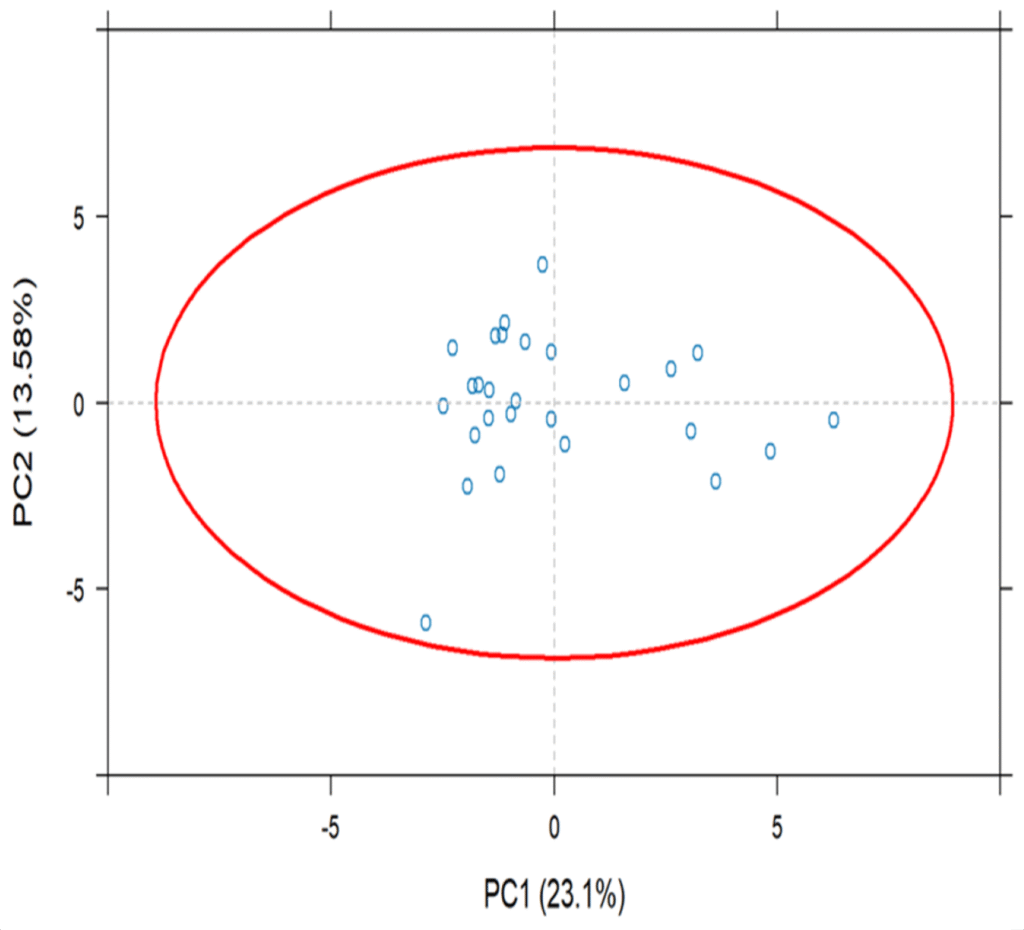
Figure 13. PCA results of most frequent words data.
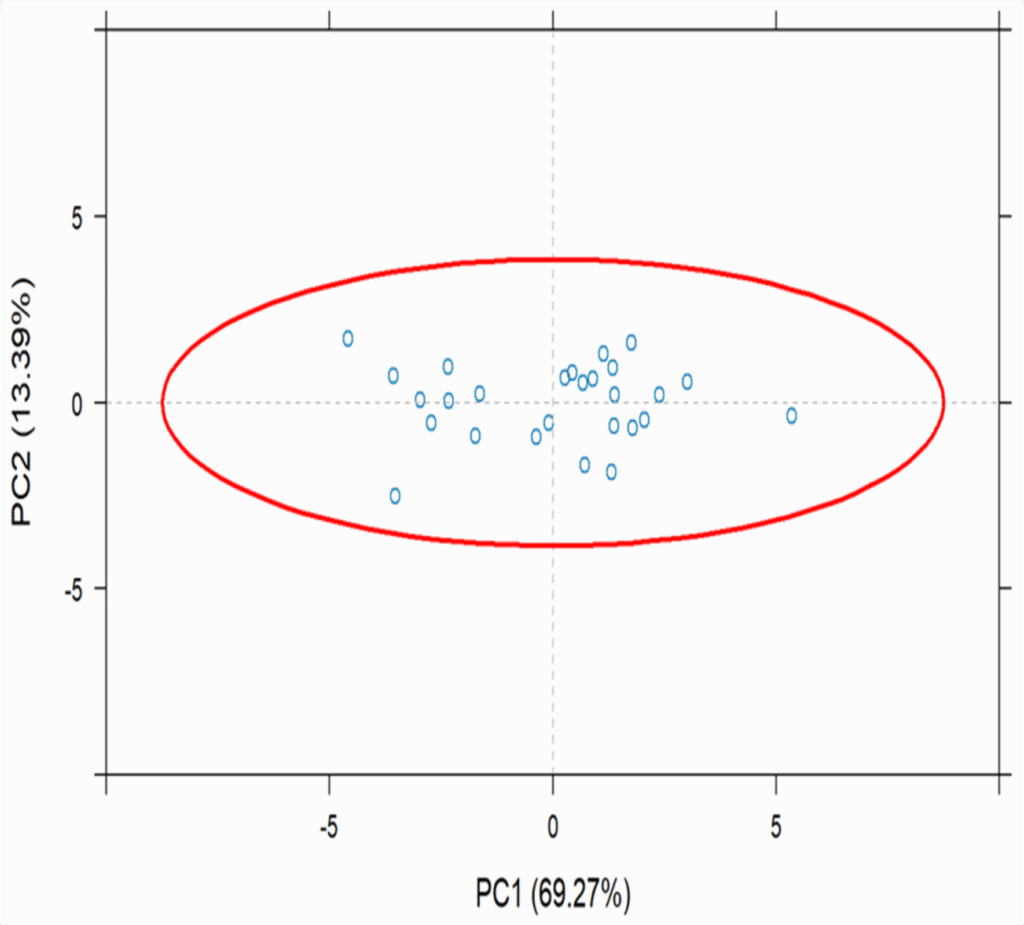
Figure 14. PCA results of other features data.
- Using Lloyd’s split of section 132 with our candidates’ texts, [Page 68]we performed SDA analyses, yielding the same results as discussed in the main body of this paper.
- Using Lloyd’s split of section 132 with our candidates’ texts, we performed multidimensional PCA, yielding results similar to our SDA results.
We conclude that Lloyd’s analysis is inadequate and that his assertions are misleading.
[Authors’ Note: We wish to thank Alex D. Smith, historian with the Church History Department of The Church of Jesus Christ of Latter-day Saints, for his assistance in identifying potential candidate authors of section 132, and appropriate representative documents for comparative analysis. We also wish to thank the anonymous reviewers for their time spent reviewing this article and for their many suggestions that have greatly strengthened its final form.]

Paul J. Fields is a professor of biomedical research, biostatistics, and bioethics at St. George’s University in Grenada. He graduated from The Pennsylvania State University with a PhD with specialization in statistics. He also holds a Master of Engineering degree and an MBA from Brigham Young University. He has authored or co-authored over 500 research studies on topics ranging from medicine to literature. Interestingly, in addition to other Church service roles, he has served as a Gospel Doctrine teacher in every ward he has lived in for the past fifty years.

Steven T. Densley Jr. is a Utah attorney (JD, Brigham Young University). He graduated with University Honors from BYU with a combined BA/MA in public policy and political science. He has published articles in the Utah Bar Journal, the Journal of Law and Family Studies, Interpreter, Meridian Magazine, and Public Square Magazine. He currently serves as executive vice president of The Interpreter Foundation. He was the executive vice president of FAIR from 2013–15, a recipient of the John Taylor Defender of the Faith Award, and was a producer of FAIR’s podcast when it twice won the People’s Choice Award for Best Podcast in the Religion & Spirituality category. He has served as an elders quorum president, high councilor, stake executive secretary, bishopric first counselor, young men’s president, gospel doctrine teacher, and is currently a Sunday School president. He and his wife Heather have four children and three grandchildren.
Matthew Roper is currently a Research Scholar at the Neal A. Maxwell Institute for Religious Scholarship at Brigham Young University. He received a B.A. in History and a M.A. in Sociology from Brigham Young University. He has published numerous articles and review essays on issues relating to Latter-day Saint history and Scripture.
Larry Bassist has over forty years of experience in statistical analysis specializing in both quantitative and qualitative analyses. He has worked in the pharmaceutical and electronics industries, taught statistics at Brigham Young University—where he earned a Master’s degree in Applied Statistics—and currently does training and consulting with Breakthrough Consulting Group. He has contributed professionally to publications and presentations on diverse topics in statistical science as well as in the digital humanities. As an avid genealogist, his greatest personal interest is in Family History.
 Facebook
 X
X Youtube
 Tiktok
 Instagram
2 Comment(s)
Loren Spendlove, 11-09-2025 at 8:08 pm
Wonderful! Thorough and well-presented. Thank you so much! The graphics were a great addition.
Bryan Thomas, 11-09-2025 at 1:53 pm
By far the most comprehensive roundup on the provenance of D&C 132 regarding superficial claims by those who deny Joseph Smith received the revelation. Given the substantive evidence presented, this appears to be an open and shut case that leaves no room for further dispute. Well done! Thank you all for rolling up your sleeves and digging in on this issue.